

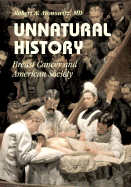
Unnatural History explores the change over the last 200 years in our experience of breast cancer--the occurrence, the medical response and the public and personal attitudes about the disease. Dr. Aronowitz's position is that "we have oversold both the fear of breast cancer and the effectiveness of screening and treatment, leading to miscalculation at the individual and societal levels." We seem to be surrounded by breast cancer: friends, relatives, ourselves diagnosed; pink everywhere, from a cat-shaped wine bottle with a remembrance ribbon to thousands of T-shirted women Walking for the Cure; constant public-service messages; and the omnipresent dread where all women seem to be waiting for the inevitable diagnosis, even though if 1 in 8 women get breast cancer, 7 in 8 won't. Women fear it more than any other disease, and Aronowitz explores the reasons why in this academic, yet highly accessible, work, analyzing "the historical change over the last two centuries from isolated, private fears of breast cancer to immense individual and collective concern over the risk of breast cancer."
He structures his book around the experiences of women, starting in 1813 with Susan Dillwyn Emlen, a Quaker from a tightly-knit family; he discusses the experience of Rachel Carson in the 1960s, who was publicly silent about her breast cancer but whose relationship with her doctor expressed the continuity with earlier women "in the efforts of patients, physicians, and others to find some balance among sustaining hope, retaining trust, and honesty"; he excerpts letters and diaries of these and other women, their families and doctors, whose stories add an intense personal dimension to his study. During Emlen's life, cancer was not seen as a great danger, since widespread infectious and epidemic diseases were more deadly. Surgery was not a preferred option--it was a horrific procedure, done without anesthesia, and not very effective; however, some women chose it because surgery was the antithesis of resignation. The introduction of ether in the 1840s meant that more surgery was performed, and along with a heightened sense of surgical responsibility, by the early 20th century the central element in cancer campaigns was "do not delay" if any symptoms are noticed, and individual responsibility was stressed. The increased visits to doctors concerning cancer signs, and the resulting improved survival statistics, created a cascade effect of even more check-ups; at the same time, increasing women's fear about cancer was considered quite effective, and was presented in a highly moralistic manner ("If she does not watch for those signs . . . she has no one to blame for the consequences but herself."). The delay message also "allowed physicians to blame time or the patient rather than their surgery or disease concepts if a bad outcome ensued."
By the 1960s, it was clear that little progress had been made against breast cancer, in spite of the awareness campaigns and medical research. The response was to create a mass surveillance of symptom-less women, and cancer activists wanted a means of prevention that was more technological, that "paid back" the public in the present for their investment in research for future gains, and that fit the needs of the cancer establishment and the realities of American private medical practice. As mammography became the standard screening procedure, individual responsibility shifted to all adult women, resulting in more diagnoses, especially of minimal and non-invasive disease.
Current challenges include stubborn mortality rates for breast cancer: they had remained virtually level from the 1930s to the 1990s, falling only slightly in the past few years. At the same time, the odds of getting breast cancer have increased, while the fear of getting it has increased dramatically. Breast cancer risk is not merely a set of numbers, it is a set of practices and beliefs that seem so necessary and logical that they are not subject to critical inquiry. Aronowitz's book is a lead-in to this inquiry, as he considers risk statistics, the way efforts to control the increase in risk have perpetuated fear, the blurring of risk and disease, the marketing of risk-reducing medications and doctor-patient relations. "Fear of cancer has reached so intensely and intimately into our lives and the allure of control has been so incessantly promoted that the experience of cancer risk in American society has a unique, self-sustaining existence."
Dr. Aronwitz has written a compelling and rich history, so much so that a review can barely skim the highlights. In addition, he wants us to think critically about risk evaluation. Aronowitz hopes that knowledge of this history will help clinicians and patients respond more thoughtfully to the challenges presented by the many options we have for confronting breast cancer.--Marilyn Dahl