

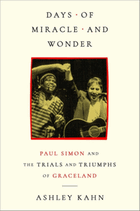
One of the 20th century's most enduring pop albums is Graceland, Paul Simon's 1986 work that incorporates South African musical styles and artists. The production of that album, and the controversy behind its creation at a time when apartheid was still a political issue, is the subject of Days of Miracle and Wonder, a lovingly detailed book by music historian Ashley Kahn (The House That Trane Built). In 1984, Norwegian musician Heidi Berg loaned Simon "a bootlegged tape, produced an ocean away, passed from hand to hand." The music on the tape was Gumboots: Accordion Jive Hits, Volume II, a collection of South African tunes in a style Simon likened to 1950s rock and roll. He incorporated that style into his next album. The result was magical, but politics complicated its creation.
Kahn expounds on every aspect of Graceland. He describes Simon's initial trip to Johannesburg to meet South African musicians, some of whom were wary of the American visitor; his recording sessions with the likes of Ladysmith Black Mambazo, the choir group who sang in Zulu and whose contributions on two songs "became one of the defining elements of the album"; and the eventual release, with Graceland becoming "a slow-yet-steady, word-of-mouth, momentum-building phenomenon." Kahn inevitably addresses the album's numerous controversies, such as Berg's feeling that Simon stole her idea and allegations that Simon violated the U.N. ban on performing in South Africa. A great album deserves a great analysis, and that's what Graceland receives in Kahn's celebratory work. --Michael Magras, freelance book reviewer