

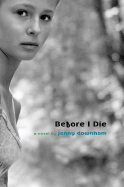
 "I wish I had a boyfriend. I wish he lived in the wardrobe on a coat hanger," begins Downham's debut novel, instantly conveying the 16-year-old British narrator's humor and universal appeal. Readers quickly learn, however, that Tessa Scott was diagnosed with leukemia, and her wish smacks of urgency. She begins making a list of the 10 things she wants to do before she dies, and the first of these is sex. Her friend Zoey's "got a plan," and the two embark on the first of many adventures. The novel, extraordinary for its unflinching depiction of Tess's psychological and physical hardships, will also have readers laughing so hard that the poignant moments creep in unexpectedly. Tess, realizing that the first wish on her list is about to be fulfilled, for instance, nearly chickens out: "I can't do it!" she tells Zoey, who replies, "You can! Live fast, die young, have a good-looking corpse!" When Tessa discovers that sex for its own sake feels empty, she adds "love" to her list.
In this portrait of a family, in which each of its members deals with Tessa's imminent death in his or her own way, the author makes nary a false step. To Downham's credit, the dysfunction does not magically cease as the teen grows sicker. Tessa still argues with her younger brother; her mother, who left the family four years before for another man, continues to be unreliable; and Tessa's controlling father grips even harder. In another humorous exchange that ends with a wallop, Tessa's father tries to help his daughter achieve #6 on her list, "fame," by getting her on a radio talk show. "Now, what do we mean by fame, eh?" Dad asks her. "I mean Shakespeare," thinks Tessa; clearly the talk show doesn't cut it. But Dad had ulterior motives: to raise enough money on the show to send Tessa to the States for cutting-edge treatment, and Tessa levels with him, "I want you to stop, Dad." "Stop what?" says he. "Stop pretending I'm going to be all right." Tessa may assume the adult role in her family, but she also never stops being a teenager. Zoey points out to Tessa how selfish she is being when Zoey admits she is pregnant and needs a friend, too. Zoey's struggle to decide whether or not to have the baby resonates with Tessa's impossible desire to live. Readers know the novel's ending from the start. What makes this journey worth taking is watching Tessa check off the items on her list; she lives each moment to the fullest, and inspires everyone around her--including readers--to do the same.--Jennifer M. Brown