

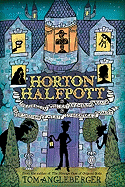
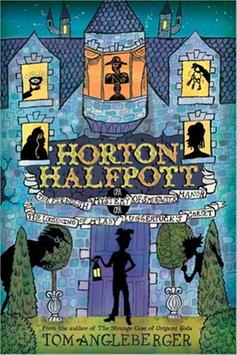
 Taking a completely different tack from his novel-comics
hybrid, The Strange Case of the Origami
Yoda, Tom Angleberger masterminds a Victorian-era farce along the lines of
Dickens, but with a broad humor more akin to Thackeray. The subtitle offers a
hint to the comedy herein: "Or, The Fiendish Mystery of Smugwick Manor,
Or, The Loosening of M'Lady Luggertuck's Corset." Everyone in Horton
Halfpott's world knows his or her place, including Horton, who's at the bottom
of the pyramid, and M'Lady Luggertuck, who's at the top. M'Lady Luggertuck long
ago elbowed aside her father-in-law, "kindly" Old Lord Emberly
Luggertuck, relegating him to the gameskeeper's cottage in the woods (where, he
later confesses to Horton, he's been "much happier"). M'Lday's
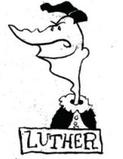
insufferable son, Luther, is far worse than she. Nonetheless, the servants of
Smugwick Manor must tolerate Luther's ruthless shenanigans because of his
higher status.
Taking a completely different tack from his novel-comics
hybrid, The Strange Case of the Origami
Yoda, Tom Angleberger masterminds a Victorian-era farce along the lines of
Dickens, but with a broad humor more akin to Thackeray. The subtitle offers a
hint to the comedy herein: "Or, The Fiendish Mystery of Smugwick Manor,
Or, The Loosening of M'Lady Luggertuck's Corset." Everyone in Horton
Halfpott's world knows his or her place, including Horton, who's at the bottom
of the pyramid, and M'Lady Luggertuck, who's at the top. M'Lady Luggertuck long
ago elbowed aside her father-in-law, "kindly" Old Lord Emberly
Luggertuck, relegating him to the gameskeeper's cottage in the woods (where, he
later confesses to Horton, he's been "much happier"). M'Lday's
insufferable son, Luther, is far worse than she. Nonetheless, the servants of
Smugwick Manor must tolerate Luther's ruthless shenanigans because of his
higher status.
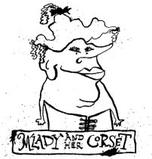 One day, M'Lady loosens her corset just a bit, enough to
ever-so-slightly lessen her iron grip on the estate. She says yes to her sister's
request to have her nephew, Montgomery Crimcramper, stay for a few weeks to
court a young heiress, Miss Celia Sylvan-Smythe, who's staying near Smugwick
Manor for the summer. M'Lady also decides to host a masquerade ball in the
heiress's honor. Luther spies an opportunity to insert himself and win the hand
of Miss
One day, M'Lady loosens her corset just a bit, enough to
ever-so-slightly lessen her iron grip on the estate. She says yes to her sister's
request to have her nephew, Montgomery Crimcramper, stay for a few weeks to
court a young heiress, Miss Celia Sylvan-Smythe, who's staying near Smugwick
Manor for the summer. M'Lady also decides to host a masquerade ball in the
heiress's honor. Luther spies an opportunity to insert himself and win the hand
of Miss 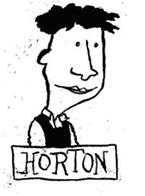 Celia and her pots of money. While our hero, Horton the lowly
dishwasher, delivers invitations to the guests, he encounters Miss Celia
Sylvan-Smythe, who is taken with his kind ways. Chaos ensues.
Celia and her pots of money. While our hero, Horton the lowly
dishwasher, delivers invitations to the guests, he encounters Miss Celia
Sylvan-Smythe, who is taken with his kind ways. Chaos ensues.
Luther's plot to woo the heiress involves taking key items
of value from Smugwick Manor, including his mother's favorite wig and the
prized "Lump" of untold value, to the Luggertucks. The theft of the
Lump ("possibly the world's largest diamond and certainly the ugliest")
prompts M'Lady to hire "the great detective" Portnoy St. Pomfrey. The
imminence of the masquerade ball and the investigation of the stolen items
provide a cornucopia of opportunities for mistaken identity and runaway
allegations. Angleberger's omniscient narrator makes plain his affection for
characters like Horton, Celia, Lord Emberly and the stableboys (enlisted as
 assistants by Portnoy St. Pomfrey), while barely masking his disdain for the
likes of Luther and the intolerant kitchen captain, Miss Neversly (who often
hits Horton with a wooden spoon). However, Angleberger also proves that even "shipless
pirates" (hired by Luther to help with his evil plot) have morals. The
author reveals the workings of the Victorian class system ingeniously and
comically, through props such as coveted candlesticks, the only source of
light. M'Lady insists on new candles every night; the better servants get her
rejects, and the lowliest (such as Horton) salvage the stubs. It may not
surprise you that though these servants be bottom-dwellers, they are the most
enlightened. Angleberger delivers many spoonfuls of sugar alongside the moral
of this Victorian fable.--Jennifer M. Brown
assistants by Portnoy St. Pomfrey), while barely masking his disdain for the
likes of Luther and the intolerant kitchen captain, Miss Neversly (who often
hits Horton with a wooden spoon). However, Angleberger also proves that even "shipless
pirates" (hired by Luther to help with his evil plot) have morals. The
author reveals the workings of the Victorian class system ingeniously and
comically, through props such as coveted candlesticks, the only source of
light. M'Lady insists on new candles every night; the better servants get her
rejects, and the lowliest (such as Horton) salvage the stubs. It may not
surprise you that though these servants be bottom-dwellers, they are the most
enlightened. Angleberger delivers many spoonfuls of sugar alongside the moral
of this Victorian fable.--Jennifer M. Brown