


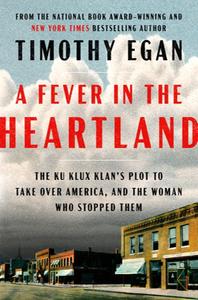
 With right-wing extremism on the rise in the United States in 2023, former New York Times columnist Timothy Egan's A Fever in the Heartland: The Ku Klux Klan's Plot to Take over America, and the Woman Who Stopped Them arrives at a critical moment. This engrossing story of the revival of the Ku Klux Klan in the early 1920s and its precipitous fall is a chilling cautionary tale for anyone concerned about the persistence of racism, antisemitism and other forms of bigotry in American society.
Egan's book focuses on D.C. ("Steve") Stephenson, an eighth-grade dropout from Texas who rose in a few short years from anonymity to become the most powerful political figure in the state of Indiana. He served as the state Klan's Grand Dragon, leading a membership, at its pinnacle in 1924, of some half a million and a private militia of 30,000 men. But the "Old Man" (in his early 30s at the height of his power) didn't rely solely on keen political acumen to fuel his dominance.
Stephenson skillfully ran an extensive organized crime network that used bribery, blackmail and brute force to control politicians, ministers, judges and law enforcement officials at every level, and that provided protection for illegal activities that included rampant terrorism against Blacks, Jews, Catholics and immigrants, along with bootlegging during the Prohibition era. Stephenson was also a violent sexual predator, and it was that flaw that triggered his downfall.
In March 1925, he kidnapped Madge Oberholtzer, a young Indianapolis woman who had entered his orbit innocently seeking help in retaining her state job. On a train to Chicago, Stephenson savagely raped Madge, covering her body with deep bites, and driving her to attempt suicide with bichloride of mercury tablets. Madge died an agonizing death 29 days later, but not before providing a graphic declaration describing Stephenson's brutality that became the centerpiece of his murder trial. Egan (The Immortal Irishman) provides a vivid account of that trial in the tiny town of Noblesville, Ind., when a jury of 12 men, three of them likely Klan members, were called upon to provide justice.
But A Fever in the Heartland is about much more than one man's abuse of power and personal depravity. In its thorough, frank depiction of how easily millions of Americans were mobilized to support a movement grounded in hatred for anyone who was not a native-born, white Protestant, it's a reminder of the need for vigilance against such threats. It can happen here, Egan reminds Americans, because it did. --Harvey Freedenberg, freelance reviewer
Shelf Talker: Timothy Egan's account of the rebirth of the Ku Klux Klan in the 1920s is both a valuable work of history and a reminder of the persistent dangers of violent right-wing extremism in the United States.