

"Sometimes you just want to live inside a book," author Jeanette Winterson once wrote in the Times of London. "In Paris this can happen quite literally, thanks to what might be the world's most exciting bookshop: Shakespeare and Company.... The ethos is as it ever was--two floors of books of every kind, new and second-hand, and a library for browsers, along with a piano if you feel like playing it... staffed by fresh-faced and optimistic twentysomethings from around the world."
Shakespeare and Company is celebrating its 75th anniversary this year, and oh what an adventure it's been. The legendary bookshop's history is well-chronicled, and a refresher course is available on its website. During August and September, the bookseller was sharing images and memories from its archives on social media, including:
|
|
| George Whitman | |
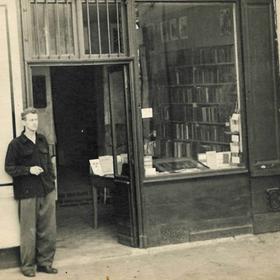
The Façade: "1951. Opening day. George Whitman stands outside his new bookshop, a former épicerie he bought with a small inheritance. The building had been condemned back in the late 19th century. George took a chance, and a home for wandering readers and writers was born on the Left Bank of the Seine.... Our facade has weathered decades of change. So has the world around it. But walk through that door, and you’ll find the spirit exactly as it was in 1951."
The Events: "A bookshop is more than just a room full of books. It's a place for readings, for gatherings... for happenings! A place full of people, voices, and discussions about literature, politics, and poetry. Events have been at the heart of Shakespeare and Company since the very beginning. Over 75 years, we’ve hosted thousands of writers upstairs, downstairs, and outside. From Nobel laureates to completely unknown poets, as well as novelists and musicians, artists and eccentrics, all given the same welcome. Even when the bookshop was closed by the French authorities in the late 1960s as part of «Operation Anti-Beatnik», the readings continued."

|
|
| Kitty | |
The Cats and Dogs: "Not every bookseller at Shakespeare and Company over the years has been human. From the early days, cats and dogs have curled up on piles of books, or prowled between the shelves here, greeting readers at opening, keeping the stock (and laps) warm throughout the day and long into the evening. George had a simple system for naming the cats: every one was called Kitty, after Anne Frank’s diary. Less time spent remembering names meant more time for reading!... The dogs, on the other hand, tended to have names.... And let’s not forget the hundreds of animals that you have brought in over the years. We love meeting them all, though the pig who lived on a nearby houseboat for a few years will always hold a special place in our hearts."
There are also the pilgrims. The Economist noted recently that the bookshop has "around 2,000-3,000 people visit each day--nearly 1 million a year," though it's hard for me to imagine how that math works, given its size.
Fortunately, we made our pilgrimage to Shakespeare and Company in 2013 on a particularly weather-bitten March day in Paris that may have kept the crowds at bay. My wife and I had begun the morning with innocent optimism at the Musée d'Orsay, where we discovered a line of tourists and students outside, snaking around the plaza and down the street.
 |
|
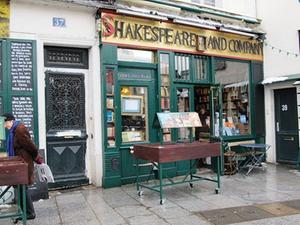
| Accidental portrait of Martha, the columnist's wife, browsing in front of Shakespeare and Company bookstore in Paris | |
We just kept strolling along the slick sidewalks in the general direction of our next goal, Shakespeare and Company, which would, we were certain, offer much-needed warmth and shelter from the storm to a couple of weary readers. We were right. The quiet inside the cozy bookshop was almost as breathtaking as the cold wind had been. We browsed for a long time, exploring the ground floor stacks as well as the library upstairs.
Because it's just my nature, even when on holiday, I also observed the booksellers, who were young and knew their stuff, fielding questions in French from the locals; changing direction instantly for an Australian man's query about "social justice in literature"; then deftly handling an American woman's request for some Ken Follett, Nora Roberts or Pat Conroy. It was a drill most frontline booksellers would recognize: Plus ça change, plus c'est la même chose, more or less.
The general air of serenity could also have been inspired by the shop's neighbor, Notre Dame Cathedral. Even an energetic band of chaperoned young Americans toned it down a notch inside the bookshop, reminding me that hushed conversations from unexpected sources are also a form of quiet.
I spent a considerable amount of time browsing the iron-gated little poetry section. Naturally, we bought several books, and had them approved with the bookshop's signature rubber stamp. and then we ventured back outside for a wet and chilly walk back to our rental apartment.
More than a decade later, the privilege of crossing the bookshop's threshold remains, for me, a special kind of bookish holy moment. And it seems particularly apt--during a week when a certain online mega-corporation is running yet another in an endless series of "Prime Days"--to end this column with the words Bruce Handy used in a 2014 Vanity Fair piece on Shakespeare and Company: "There are reasons this English-language bookshop is a destination, far from Amazon."
So, happy 75th birthday, Shakespeare and Company. It's good to know you're still there, living inside a book.