
| Publisher: | Holt | |
| Genre: | Friendship, Dystopian, Literary, Fiction | |
| ISBN: | 9781250399342 | |
| Pub Date: | December 2025 | |
| Price: | $17.99 |
| Starred | Fiction |
by Matt Greene
Matt Greene's The Definitions is a transfixing and economical dystopian novel, deftly using its scant pages to speak volumes about language and the construction of identity. The unnamed narrator recounts her experience at the Center, a facility designed to rehabilitate its occupants after a virus and a massive data breach that renders them unknown to themselves and to anyone else.
Though the residents of the Center are adults, they must relearn the most basic of concepts as they await the return of their memories and of their words. Their acquisition of language contributes to a developing sense of self, a process that should lead to graduation and their reintegration into life outside the Center.
The narrator seems to hold language itself as the goal, and through her voice, Greene assembles a dizzying collection of metaphors, each brilliant and revelatory: "Snow fell in asterisks, a million silent caveats." Despite steady growth, the residents don't seem any closer to recalling who they were, and some start to question the stories they've been told. Chino, a resident who has already tried and failed at the reeducation process once, develops multiple theories: there was no virus; there was a virus, but the Center was responsible for it; they are robots. Most, however, accept their fate without question, just as they accept the lessons they are taught--poems have to rhyme, there are two genders, dogs are mythical creatures.
The Definitions offers no tidy resolution; there is no act of discovery or resistance that reveals the truth of the Center. But the story is thoroughly satisfying, as controlled and complete as a perfectly crafted sentence. --Sara Beth West, freelance reviewer and librarian
| Publisher: | Harper | |
| Genre: | Psychological, Dark Humor, Humorous, Satire, Literary, Thrillers, Fiction | |
| ISBN: | 9780063445277 | |
| Pub Date: | December 2025 | |
| Price: | $30 |
| Starred | Fiction |
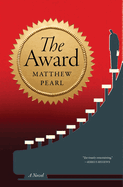
by Matthew Pearl
A darkly entertaining satire set in present-day Cambridge, Mass., The Award by Matthew Pearl tells the story of an unscrupulous writer's improbable rise to the upper echelons of literary society. It is a superb caricature of a ruthlessly ambitious young man who will stop at nothing, even murder, to claw his way to the top.
Armed with an MFA, dwindling funds, and an endlessly patient fiancée, David Trent is "always trying to finish the same first novel" while fending off panic that "he could never be good enough." His rival is the self-assured, Harvard and Iowa Writers Workshop-educated Barnaby Masters, whose career trajectory, in Pearl's marvelously twisted plot, is inextricably linked to David's.
When David and his intended, Bonnie, rent an apartment above that of renowned author and New Yorker fiction editor Silas Hale, David is convinced the proximity to literary greatness will rub off on him. Remarkably, it does. David wins the "Boston Literary Prize for Best First Novel" for his debut, a feat that catapults him to national fame. Barnaby is grudgingly impressed, as is Silas, a mean old curmudgeon who bullies his new neighbor. But how far will David go to maintain his literary perch?
Pearl (The Last Bookaneer), wickedly witty in describing his compatriots, refers to writers as "domesticated dogs, easily suspicious just at the sight of each other for no particular reason." Luck, "a Cambridge writer's most coveted commodity," might be on David's side for a time, but in the end, it is Barnaby who turns out to be the perfect foil for the spectacular moral reckoning Pearl has in store for his cunning protagonist. --Shahina Piyarali
| Publisher: | Viking | |
| Genre: | Psychological, Literary, Suspense, Thrillers, Fiction | |
| ISBN: | 9781984882189 | |
| Pub Date: | November 2025 | |
| Price: | $30 |
| Starred | Fiction |
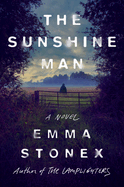
by Emma Stonex
Emma Stonex's second novel (after The Lamplighters) is a slow-burn psychological revenge thriller that uses multiple timelines, points of view, and geographic locations to create a layered and nuanced portrait of human nature and the need for adequate nurturing.
The Sunshine Man begins in 1989 as Birdie, one of two narrators, learns that Jimmy Maguire, the man who killed her sister, Providence, is being released from prison. Taking the gun she has saved for this occasion, Birdie leaves her family in London and travels to Devon to track down and kill Jimmy. Along the way, Birdie recalls her childhood: abandoned by her mentally unstable mother but raised, along with Providence, by a loving grandmother. Jimmy, the youngest of a troubled, violent family forever on the wrong side of the law, was taken in by Birdie's family and grew close to Providence until a series of disturbing events upended all their lives. The second point of view is Jimmy, whose narrative alternates between flashbacks to his youth, his prison diaries, and the present, when he senses he is being stalked. Stonex skillfully juxtaposes the two points of view to illustrate how differences in perception can have devastating consequences.
Moody, suspenseful, and filled with some surprising twists, The Sunshine Man succeeds as a literary thriller. However, Stonex offers her readers much more with a novel that excavates questions of how people can be shaped by their earliest relationships and how access to basic support systems throughout someone's life can not only alter its trajectory but allow for redemption. --Debra Ginsberg, author and freelance editor
| Publisher: | Riverhead | |
| Genre: | Short Stories (single author), Magical Realism, Literary, Fiction | |
| ISBN: | 9780593716380 | |
| Pub Date: | December 2025 | |
| Price: | $28 |
| Fiction |
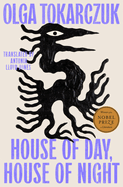
by Olga Tokarczuk, trans. by Antonia Lloyd-Jones
Polish Nobel laureate Olga Tokarczuk (Drive Your Plow over the Bones of the Dead) has described her literary works as "constellation novels," a label that fit her 2018 novel, Flights, winner of the Man Booker International Prize. To the extent that term describes a collection of often seemingly disparate narrative strands that invites the reader to assemble them into patterns of meaning, it's also an apt characterization of House of Day, House of Night. Antonia Lloyd-Jones's English translation is a beautifully allusive collage of fully formed short stories, memorable character studies, and glimpses of small-town life.
Tokarczuk's novel is set in the region of Silesia. Anchoring it are an unnamed contemporary narrator and her neighbor, an elderly woman named Marta, best known for her skill as a wigmaker and her familiarity with the local flora. The novel comes to life in its assortment of diverse short stories, some of them self-contained, others segmented throughout the book. Among the most striking involves Paschalis, a young monk who makes it his mission to secure sainthood for Kummernis, a beautiful woman from the medieval period crucified by her father after she miraculously grows a beard resembling Christ's to thwart his demand that she marry one of his fellow knights. As Paschalis immerses himself in her story, he grapples with his own sexual identity.
Spanning hundreds of years, House of Day, House of Night pulses with the power of dreams, visions, and symbols. There's nothing extraordinary about the region in which it's rooted, or the modest lives of the people who live there, but in the hands of Olga Tokarzcuk their stories flourish. --Harvey Freedenberg, freelance reviewer
| Publisher: | Farrar, Straus and Giroux | |
| Genre: | World Literature, Austria, Literary, Fiction | |
| ISBN: | 9780374616151 | |
| Pub Date: | December 2025 | |
| Price: | $26 |
| Fiction |
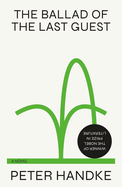
by Peter Handke, trans. by Krishna Winston
Controversial Nobel laureate Peter Handke's novel The Ballad of the Last Guest is a slim, elegant mood piece, intended more to evoke feelings and emotions than to tell a conventional story. Anyone willing to surrender to its melancholy sensibility on those terms will be rewarded with a meaningful reading experience.
Gregor Werfer returns to his childhood home for a weeklong visit highlighted by the baptism of his younger sister's baby boy, his godchild. But even as he rejoins his family, he's burdened by his knowledge of a terrible secret. Unbeknownst to his parents and sister, their son and brother Hans, serving in the Foreign Legion of an unnamed country, has been killed by an enemy bullet, his body buried immediately in the tropical country where he was fighting. But instead of unburdening himself of his grief to his family, Gregor abandons them to embark on a restless, solitary odyssey through the environs of New Town. A veteran of what he calls "my one-man expeditions," he's a keen observer of his shifting surroundings by day, while he spends his nights in a trolley barn, a forest, an unused village church, and an assortment of welcoming taverns where he earns his eponymous title.
Handke creates a world infused with intense sensory detail while fully inhabiting Gregor's psyche, as the enigmatic character confronts memory and loss. The Ballad of the Last Guest is saturated with a reflective spirit. In the final section, Gregor primarily summons up a generous sampling of striking images drawn from all that has gone before. It's a fitting conclusion to an impressionistic novel that casts a memorable spell. --Harvey Freedenberg, freelance reviewer
| Publisher: | Thomas Nelson | |
| Genre: | Women, Family Life, Romance, Contemporary, Southern, Fiction, Siblings | |
| ISBN: | 9781400345663 | |
| Pub Date: | November 2025 | |
| Price: | $18.99 |
| Fiction |
by Grace Helena Walz
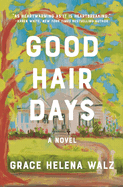
Grace Helena Walz's charming second novel, Good Hair Days, follows the fortunes of a small-town Georgia hair salon and the quirky, bighearted family of women determined to keep it afloat.
For generations, June's Beauty Shop has been a community institution in tiny Whitetail, Ga. Run by the Louise women and passed down the generations, the shop needs a refresh. When Junie's attempts at a renovation leave her with torn-up floors and a leaking bank account, she calls on big sister Georgia--the one who escaped to Atlanta--to come home and save the day. But Georgia is hiding secrets of her own. To save the shop, the sisters must get creative, running schemes including bake sales and illicit poker nights with hilarious and sometimes unexpected outcomes.
Walz (Southern by Design) expertly captures the sturdy ties (stronger even than Junie's hair spray) that bind the Louise women. Each of them--Junie, Georgia, and their aunts, Tina and Cece--must decide for herself where she fits into the shop's future, while reckoning with the legacy of Junie and Georgia's beloved dead mother and the weight of family history. As they work together to rescue June's Beauty Shop, all four women learn to lean on one another (with a little help from their patron saint, Dolly Parton).
Laced with sweet tea and Southern sass, Good Hair Days is a tribute to sisterhood, hard work, ingenuity, and the power of a well-crafted hairstyle. --Katie Noah Gibson, blogger at Cakes, Tea and Dreams
| Publisher: | Spiegel & Grau | |
| Genre: | Women, Medieval, Religious, General, Literary, Fiction, Historical | |
| ISBN: | 9781966302056 | |
| Pub Date: | December 2025 | |
| Price: | $30 |
| Fiction |
by Janet Rich Edwards
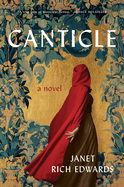
Janet Rich Edwards's fierce, luminous debut novel, Canticle, follows a young woman named Aleys in 13th-century Belgium as she seeks a deeper connection with God and runs afoul of the ambitious men who control the local church. Edwards's narrative explores dynamics of love and power, the complexities of faith, and the quiet influence of the beguines, a group of independent women who live in community, committed to serving God and one another.
Growing up the daughter of a wool merchant in Bruges, Aleys loves her mother's retellings of the stories of saints and prophets. She refuses marriage to an associate of her father and joins the Franciscan friars. They find shelter for her in the beguines' compound, the begijnhof. Friar Lukas, Aleys's Franciscan spiritual adviser and mentor, is convinced she has been touched by God, but his brother, local bishop Jaan, is both unsettled by Aleys's spiritual passion and determined to use her as a pawn in his power games.
Edwards draws sharp contrasts between Aleys's genuine search for faith and the calculating power plays undertaken by Jaan and other religious leaders. While Aleys is intelligent and hungry for spiritual experience, her youth and naivete leave her susceptible to others' machinations. As Aleys attracts more attention from Jaan and other corrupt church officials, she is forced to face new kinds of trials, and redefine the meaning of devotion and sacrifice.
Thoroughly detailed and sensitively told, Canticle is an exploration of a young woman's hunger for a deeper purpose, a sharp-eyed examination of power's corrosive effects, and a testament to the impact of quiet, faithful service like that of the beguines. --Katie Noah Gibson, blogger at Cakes, Tea and Dreams
| Publisher: | Park Row | |
| Genre: | Women, Family Life, Small Town & Rural, General, Romance, Contemporary, Fiction | |
| ISBN: | 9780778310853 | |
| Pub Date: | November 2025 | |
| Price: | $18.99 |
| Fiction |
by Jamie Brenner
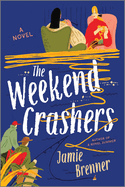
Maggie is thrilled when the modeling career of her 23-year-old daughter, Piper, begins to take off. Maggie's own career was derailed when she became pregnant and she raised Piper on her own, and her greatest joys in life are Piper and knitting. So when Piper's biggest modeling gig to date becomes a disaster, Maggie suggests that the pair attend a knitting retreat at a quaint Pennsylvania inn.
Piper is hopeful that a relaxing weekend in the countryside will provide refuge from her public humiliation and growing anxiety that her boyfriend has changed his mind about proposing, and she agrees that the retreat at the New Hope Inn is just what she needs. However, her and her mother's plans for peace and quiet unravel when they meet the inn's other weekend guests: a bushcraft-focused bachelor party.
Maggie refuses to allow the disruption to ruin her opportunity to reconnect with Piper and strikes up a conversation with the bachelor's uncle, leading to a bet between the two groups to prove which craft is harder: knitting or bushcraft. An exciting, playful rivalry emerges as the groups put their axe throwing, knit stitches, and relationships to the test.
Jamie Brenner (A Novel Summer; The Husband Hour) creates a charming setting, complete with a welcoming cast of characters that foster a warm feeling of community, but as Maggie and Piper's tight bond comes apart at the seams, they and many others at the inn learn to mend their relationship and discover what they truly want from life. Bringing together humor and heart, The Weekend Crashers is a testament to love and second chances. --Clara Newton, freelance reviewer
| Publisher: | Biblioasis | |
| Genre: | Friendship, World Literature, Literary, Coming of Age, Europe (General), Fiction | |
| ISBN: | 9781771966801 | |
| Pub Date: | November 2025 | |
| Price: | $17.95 |
| Fiction |
by Jón Kalman Stefánsson, trans. by Philip Roughton
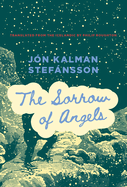
The second novel in a trilogy featuring an unnamed boy, The Sorrow of Angels by Icelandic author Jón Kalman Stefánsson (Your Absence Is Darkness) will leave readers breathless and eager for the final installment but not before taking them on an epic journey through ice, snow, and the dark corners of the human heart.
Like the trilogy's opening volume, Heaven and Hell, this fiercely intelligent title pits its characters against the capricious climate of Iceland, rightly identifying its importance early on: "The weather controls everything here, it models our lives like clay." The Sorrow of Angels begins as the boy emerges from the warmth of his new home to greet Postman Jens, frozen to the horse he's riding. Only later does the boy find he must forgo his pending education and follow Jens over the heath "on a journey, out to the end of the world. Where Iceland ends and eternal winter begins."
With a lilting, direct translation from Philip Roughton, The Sorrow of Angels describes the men and their grueling trek to deliver the mail. They are knocked down time and again by the force of nature but rise through sheer will and perseverance. This is an unremitting tale that rushes through its final pages to an unexpected and unresolved ending, but it is also a wonder, fascinating and full of truth. As Jens and the boy walk, "two men in search of themselves," they face universal questions: how to move forward despite uncertainty, how to love in the face of loss, and how to trust--themselves and others. --Sara Beth West, freelance reviewer and librarian
| Publisher: | Minotaur Books | |
| Genre: | Mystery & Detective, Traditional, Fiction, Historical | |
| ISBN: | 9781250767165 | |
| Pub Date: | November 2025 | |
| Price: | $29 |
| Mystery & Thriller |
by Charles Finch
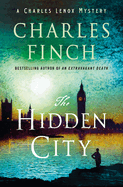
Professional and personal issues occupy British private detective Charles Lenox in Charles Finch's stylish The Hidden City, set in 1879.
As he heals from being stabbed during a recent investigation in the U.S., Lenox is drawn into a cold case involving Mrs. Huggins, his beloved former housekeeper. She relates that the previous owner of her home, a chemist with a nasty reputation, was murdered seven years earlier, and she fears the killer has returned. A stranger has been sleeping on her front stairs, and scratches at her keyhole indicate that someone attempted to break into her house. The case takes Lenox to London's backstreets, brothels, and drug dens, where opiates are dispensed.
Meanwhile, Lenox and his wife, Lady Jane, open their home to Angela, the daughter of his recently deceased cousin Jasper, who lived in India. Accompanying Angela without advance notice is Sari, an Indian girl who was taken in by Jasper; she and Angela grew up together. Lenox and Lady Jane don't hesitate to welcome both girls, though they are concerned that society may not be accepting of brown-skinned Sari. Lenox also worries about Lady Jane's safety when she joins a women's suffrage protest and threatening notes arrive afterward.
Finch (The Woman in the Water) alternates between Lenox's work and home life. Rather than link the two through a series of coincidences, Finch's purposeful separation of the business and the personal makes for a stronger story, which thoughtfully explores issues as he moves through different parts of society.
The Hidden City, Finch's 15th installment in his Charles Lenox series, moves at a brisk clip, led by an intelligent, compassionate detective. --Oline H. Cogdill, freelance reviewer
| Publisher: | Emily Bestler/Atria | |
| Genre: | Suspense, Thrillers, Fiction | |
| ISBN: | 9781668022535 | |
| Pub Date: | December 2025 | |
| Price: | $18 |
| Mystery & Thriller |
by Kit Frick
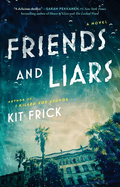
Friends and Liars by Kit Frick (I Killed Zoe Spanos) sees a foursome of estranged friends reunite at a luxurious private Italian palazzo for an extravagant weeklong vacation to remember their fifth, heiress Clare Monroe. Clare was 21 when she drowned on New Year's Eve. Now she would be 27.
Luca, Harper, Sirina, and David gather for an itinerary organized (and paid for) by Clare's family, the famous and secretive Monroes of Hollywood. The friends still care for each other, but have been out of touch since that terrible New Year's Eve. Clare's tragic death is all bound up with secrets that each of them would rather not confront again--the lies and betrayals that contributed to her demise.
But, for various personal reasons, none is able to resist the invitation to return to the Palazzo Mella. Immediately, their uneasiness is intensified by the appearance of taunting "gifts" and notes left for them in the guest quarters. The message is clear: someone knows what happened on that New Year's Eve and has come for revenge. The old friends must band together to solve a compound mystery: Who knows what they've each done? Who is preying upon their guilt? What really happened that night, and who will pay for it now?
Friends and Liars achieves a delicious balance of emotional complication, layered deceptions, and consummate psychological drama. Lush with the accoutrements of affluence and charged with the machinations of aspiring creatives, the lavish setting near Bellagio distills to a locked-room mystery. Heart-racing suspense, compelling characters and relationships, and great danger add up to a highly satisfying puzzle of a novel. --Julia Kastner, blogger at pagesofjulia

| Publisher: | Zibby Publishing | |
| Genre: | Psychological, Family Life, General, Suspense, Thrillers, Fiction | |
| ISBN: | 9798992377002 | |
| Pub Date: | December 2025 | |
| Price: | $17.99 |
| Mystery & Thriller |
by Julie Doar
Julie Doar's first novel, The Gallagher Place, investigates old and new mysteries within a compelling family drama set in a striking landscape.
Protagonist Marlowe Fisher is an illustrator living on Manhattan's Upper West Side and a loner, even surrounded by her powerful family and their estate. When she and her two brothers, as adults, discover a body on their property, the case reopens old wounds. Decades earlier, Marlowe's childhood best friend vanished without a trace. The freshly murdered man and the long-missing teenaged girl do not initially appear linked, but the surrounding community has long harbored suspicions about the wealthy Fishers. Marlowe has always yearned to know what happened to Nora, and the loss of Nora has shadowed Marlowe's life ever since, culminating in a carefully hidden drinking problem.
The recent murder, and accompanying investigation into Nora's disappearance, is both galvanizing and disturbing. As Marlowe embarks on her own inquiries, more thoroughly than ever before, she not only refreshes old pains but discovers new risks. To search for Nora means to interrogate her own memory, to learn uncomfortable truths about herself and her family, to confront class differences, privilege, and inheritances. This discomfiting process takes place in two timelines, against the backdrop of Dutchess County, N.Y., in the summers of the 1990s (when Nora and Marlowe were teenagers) and in the present winter of 2018. The Fisher property defines Marlowe's greatest trauma and coming of age. A strong sense of place is central to this chilling novel about old secrets and what one might choose to uncover or keep hidden. The Gallagher Place is dramatically atmospheric, expertly paced, and haunting. --Julia Kastner, blogger at pagesofjulia
| Publisher: | Harper Muse | |
| Genre: | Historical - Gilded Age, Mystery & Detective, General, Romance, Fiction, Action & Adventure, Historical, Women Sleuths | |
| ISBN: | 9781400347728 | |
| Pub Date: | December 2025 | |
| Price: | $18.99 |
| Mystery & Thriller |
by Lee Kelly, Jennifer Thorne
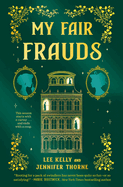
My Fair Frauds, the third historical novel jointly written by Lee Kelly and Jennifer Thorne (The Starlets), is a highly entertaining Gilded Age caper combining greed, ambition, and an unlikely friendship between two savvy women.
Forced out of her Kansas home by the ruthless city bankers who conned her father, Coraline "Cora" O'Malley is working for peanuts as a stage magician's assistant (and sometime thief), determined to save up enough money to buy back her family's farm. During a Manhattan show, Cora meets Alice Archer, who is posing as the Grand Duchess Marie Charlotte Gabriella. Alice is working a long con on the five wealthy families who cheated her father in a shady railroad deal, planning to swindle them out of their wealth in turn. Cora's presence gives Alice an inspiration: the young woman will pose as the duchess's cousin, newly arrived in New York, and help lure in her targets.
Kelly and Thorne send their protagonists racing around the city, traveling by foot, carriage, and hansom cab, as they dance and deceive their way through balls, operas, and teas. Alice and Cora will each find their mettle and their consciences tested as they speed toward the climax of their scheme. The authors delve into each woman's motivations--Alice's deep-seated need for revenge and Cora's longing for her vanished home--as well as the ways both women are determined to subvert the limits placed on women by 1880s society.
Witty, fast-paced, and packed with historical details of the smart set in Gilded Age Manhattan, My Fair Frauds is a well-plotted adventure and a satisfying twist on a classic sting narrative. --Katie Noah Gibson, blogger at Cakes, Tea and Dreams
| Publisher: | Tor Books | |
| Genre: | Gaslamp, Fantasy, Romance, Fiction | |
| ISBN: | 9781250334886 | |
| Pub Date: | November 2025 | |
| Price: | $28.99 |
| Science Fiction & Fantasy |
by Travis Baldree
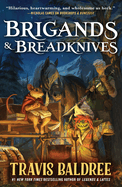
Rattkin bookseller Fern discovers that what seems like the perfect life isn't necessarily what she needs in Brigands & Breadknives, the third in the heartwarming Legends & Lattes fantasy series by Travis Baldree.
Years ago, a young orc adventurer named Viv spent a summer recuperating and working in Fern's bookshop. Readers of the series will remember the details from Bookshops & Bonedust. Viv recently settled down and opened a coffee shop, and now she has convinced Fern to move her bookshop next door in the city of Thune. But even though the renovations and grand opening of the new shop go beautifully, Fern can't shake the feelings of dissatisfaction and hopelessness that have plagued her for years. One sad and drunken night, Fern crawls into the back of a cart owned by Astryx, a legendary elven blademistress, and passes out. She wakes too far down the road to turn back, since Astryx must deliver a captive goblin, Zyll, for a bounty. Nobody's sure why Zyll has a bounty on her head, but it's big enough that it will take all Astryx's fighting skills and a bit of help from Fern to keep rival adventurers from stealing her away.
Although this entry deals with more traditional epic fantasy adventures than the previous ones, it maintains the familiar warm and fuzzy tone. Fern faces the weighty reality of disappointing people who care about her, but Baldree's clever narration and the antics of Zyll and others keep the tone from getting too heavy. Series fans and newcomers alike will delight in Fern and her friends. --Kristen Allen-Vogel, information services librarian at Dayton Metro Library
| Publisher: | Hanover Square Press | |
| Genre: | War & Military, Cultural Heritage, Epic, Fairy Tales, Folk Tales, Legends & Mythology, Fantasy, Coming of Age, Fiction, Historical, Military | |
| ISBN: | 9780778387664 | |
| Pub Date: | December 2025 | |
| Price: | $30 |
| Science Fiction & Fantasy |
by Sarah Mughal Rana
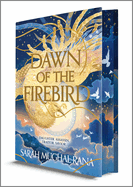
Sarah Mughal Rana's first adult fantasy in a projected trilogy, Dawn of the Firebird, is a striking and evocative epic about power, revenge, and the price of freedom, both for individuals and those caught up in the games of empires. Khamilla Zahr-zad has wanted nothing more than to be claimed and named by her father, a distant emperor who has never visited her where she lives with her mother's nomadic tribe. But when tragedy strikes in the form of a raid and the vast majority of her kin are slaughtered, a heavenly magic awakens in her--the nūr, the power to wield light.
Khamilla and her mother return to the emperor's court, where her status as one of the rare Eajīz, or magic users, to be born in her father's empire makes her useful to him. But just as she feels like she might have earned her place and found her purpose, it is ripped away from her again. In the aftermath, Khamilla finds herself behind the enemy empire's lines, a spy infiltrating their training city for Eajīz. As she learns more about her magic potential, she discovers a power and destiny far beyond what she could have imagined. Along with that, she uncovers darker truths than she expected.
Rana (Hope Ablaze) has created a remarkable saga that will not just capture the imagination but expand it as Rana draws from Islamic culture in both her world's texture and its magic systems. Dawn of the Firebird is a provocative epic that asks questions about the cost of war and power struggles on the people swept up in their machinations. --Michelle Anya Anjirbag, freelance reviewer

| Publisher: | Counterpoint | |
| Genre: | Biography & Autobiography, Cooking, Culinary, Aging, Topic, Humor, Essays & Narratives | |
| ISBN: | 9781640097384 | |
| Pub Date: | December 2025 | |
| Price: | $26 |
| Starred | Biography & Memoir |
by Betty Fussell
Betty Fussell refers to her 13th book, How to Cook a Coyote: The Joy of Old Age, as a "coming-of-death story." The Shakespeare scholar, food historian, and memoirist was born in 1927. Though "Tick tock" is a refrain as she senses time running out, her sardonic autobiographical essays burst with memories of food, friendship, sexual passion, and globe-trotting adventures.
Fussell (My Kitchen Wars) is mostly blind and since 2012 has lived in a Montecito, Calif., retirement home, Casa Dorinda--coincidentally, the alma mater of Julia Child, whose mantle she took up by reinstituting a "Breakfast Club" of five elderly intellectuals. Each 7:30 a.m. breakfast is sacred when shared with friends, whose sometimes absurd dialogue she re-creates for readers' delight.
The book's 40 miniature essays are self-deprecating and often employ a playful, inviting direct address to the reader. Fussell gives a rundown of her failing bodily systems and remarks on ironies, yet never gives way to self-pity. The coyote of the title is both literal and metaphorical here: he's the proverbial trickster, and a symbol of death in general. But the coyote is also a real animal, one she tried shooting with her son in Montana--only to wind up in an emergency room on Thanksgiving when she tore a ligament in her ankle.
While she awaits a final encounter with that wily coyote, Fussell has vibrant memories to sustain her. Many of the pieces are elegies for departed friends and family members, reminiscences of past love affairs, and accounts of memorial services. These tongue-in-cheek essays remembering sensual joys are perfect for fans of Diana Athill, Ruth Reichl, and Abigail Thomas. --Rebecca Foster, freelance reviewer, proofreader, and blogger at Bookish Beck

| Publisher: | The New Press | |
| Genre: | Nature, Technology & Engineering, Environmental Policy, Environmental, Public Policy, Environmental Conservation & Protection, General, Pollution Control, Political Science | |
| ISBN: | 9781620979457 | |
| Pub Date: | December 2025 | |
| Price: | $27.99 |
| Political Science |
by Judith Enck, Adam Mahoney
Images of plastic- and fossil fuel-related disasters and pollution, such as toxic spills and trash-strewn beaches, make the problems seem insurmountable, too big and horrible for the average person to understand, let alone start to solve. But in The Problem with Plastic: How We Can Save Ourselves and Our Planet Before It's Too Late, Judith Enck, founder and president of Beyond Plastics, and Adam Mahoney, a climate and environmental reporter, have assembled an approachable, easy-to-read, and comprehensive overview of the problem, the people already fighting back, and the steps that the average person can take to become part of the solution.
Enck and Mahoney outline the short history of society's dependence on plastic. They emphasize that corporate greenwashing of the material has been a large part of the marketing strategy alongside an emphasis on the convenience of using plastic. They show how the displacement of responsibility of plastic pollution onto consumers instead of producers has been a part of the industry's strategy. Enck and Mahoney also carefully and straightforwardly outline the harms caused to humans, animals, and the environment at all points of the plastic cycle. They paint a grim picture of an industry that has now managed to impact everyone at all levels of life, but especially the poor communities and communities of color.
Importantly, Enck and Mahoney do not just leave their readers adrift on a floating waste island of existential dread. The Problem with Plastic strongly underscores that, while the industry has power, people working together have more, and provides the baby steps needed to help the public realize its power to address plastic pollution. --Michelle Anya Anjirbag, freelance reviewer
| Publisher: | One Signal/Atria | |
| Genre: | Reproductive Medicine & Technology, Law, Abortion & Birth Control, Health & Fitness, Pregnancy & Childbirth, Medical, Social Science, Gender & the Law | |
| ISBN: | 9781668032602 | |
| Pub Date: | October 2025 | |
| Price: | $30 |
| Social Science |
by Irin Carmon
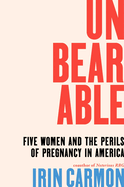
"By any measurement of pregnancy mortality, the US comes in last among the top ten comparably wealthy countries," writes journalist Irin Carmon in Unbearable: Five Women and the Perils of Pregnancy in America, explaining her motivation to report on the contradictions and dangers women in the U.S. confront and her conviction that "we all deserve so much better than this."
Carmon (coauthor of Notorious RBG) presents obstacles to women's reproductive health and rights beyond the Supreme Court's 2022 Dobbs decision overturning Roe v. Wade. She reports on five women--plus herself--who navigated the unequal, racist, and classist experience of pregnancy and birth, identifying caring and supportive professionals as well as those whose policies deny "autonomy over our lives." Her sensitive case studies of women in New York City and three Alabama locations include joyous births of cherished babies. But at the heart of her coverage are tragic episodes that illustrate what too often goes wrong with prenatal care in the U.S. Such events are often linked to the politicization of reproductive rights evolving from the 2022 decision, and they cross socioeconomic strata. Carmon includes testimonies from women denied treatment for pregnancy emergencies, and women accused of minor drug charges inhumanely incarcerated without medical care. She documents botched anesthesia administration and inattentive staff at a New York City hospital in heartbreaking detail. Midwives and home-birth centers improve outcomes, but as Carmon's reporting reveals, licensing and regulations obstruct their operations. Although her topic is steeped in both joy and anguish, Carmon's writing remains remarkably objective, inspiring a commitment to work for reproductive rights and celebrate those who already do. --Cheryl McKeon, Book House of Stuyvesant Plaza, Albany, N.Y.
| Publisher: | Algonquin Books | |
| Genre: | Nature, Trees, Environmental Conservation & Protection, Natural History, Science, General, Holidays (non religious), Plants, Social Science | |
| ISBN: | 9781643756707 | |
| Pub Date: | December 2025 | |
| Price: | $29 |
| Social Science |
by Trent Preszler
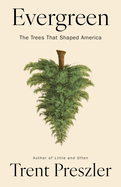
Trent Preszler (Little and Often), a professor of practice in the Charles H. Dyson School of Applied Economics and Management at Cornell University, offers readers a captivating history of the evergreen (and other trees) and its role in the development of the physical territory and culture of the United States.
Throughout history, lumber was a definitive resource in many aspects of life--including military campaigns from ancient Rome to colonial Britain--and civilizations consumed it as though it were limitless: "When the Western Roman Empire collapsed in the fifth century, southern Europe was mostly deforested, its vibrant landscapes reduced to barren hills and eroded soils."
Evergreen is particularly insightful in its examination of the foundational role of timber in the early United States. For the first colonists, the vast forests were a formidable challenge, as they hindered the development of agriculture lands and transportation of people and goods. Logging was, and remains, a singularly dangerous occupation. But the forests were also an immense opportunity. The timber trade provided the essential materials for shipbuilding, construction, and the growth of towns. One of the book's most compelling sections is a detailed chronicle of the tree's gradual assimilation and subsequent prominence within the Christian tradition. Preszler lays out the custom's pre-Christian origins in Germanic cultures, where evergreen boughs were venerated during the winter solstice as a symbol of life's endurance.
Readers of canonical "history through an object" such as Mark Kurlansky's Salt or Coal: A Human History by Barbara Freese will be spellbound by Preszler's narrative skill as he adroitly makes the various historical eras and their forests feel vibrant and alive. --Elizabeth DeNoma, executive editor, DeNoma Literary Services, Seattle, Wash.
| Publisher: | Bloomsbury Sigma | |
| Genre: | Nature, Environmental), Environmental Policy, Public Policy, Environmental Conservation & Protection, Science, General, Global Warming & Climate Change, Environmental Science (see also Chemistry, Political Science | |
| ISBN: | 9781399414050 | |
| Pub Date: | November 2025 | |
| Price: | $28 |
| Science |
by Susannah Fisher
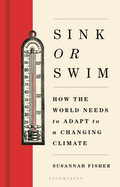
Sink or Swim: How the World Needs to Adapt to a Changing Climate by Susannah Fisher, a principal research fellow at University College London, urgently examines the challenging decisions required in the face of pressing climate change. Fisher asserts that the incremental approach of the past--making small changes with limited adoption--has not been enough to maintain a livable planet. She describes how the people and regions most vulnerable to catastrophe are the already impoverished populations who are least responsible for contributing to the climate crisis. Fisher grounds her discussion in the latest research and the immediate realities, detailing how global communities are already grappling with fallout from extreme weather events, such as heat waves, wildfires, hurricanes, and floods.
The bulk of Sink or Swim explores the difficult trade-offs and crucial choices facing governments, communities, and individuals around the world. Each chapter delves into complex, real-world issues that demand transformative action, such as whether people should be encouraged to move away from vulnerable coastlines, how to manage the stability of global food supplies, whether conflict will arise over increasingly scarce resources like water and, crucially, how solutions should be financed.
Readers of optimistic, actionable environmental works such as Bill Gates's How to Avoid a Climate Disaster will appreciate the practical nature of Fisher's book. Sink or Swim is an essential contribution to climate literature, providing an accessible and authoritative perspective that compels readers to move beyond paralysis and embrace the painstaking but necessary process of ensuring a sustainable and just future. --Elizabeth DeNoma, executive editor, DeNoma Literary Services, Seattle, Wash.

| Publisher: | Greystone Kids | |
| Genre: | Anatomy & Physiology, General, Science & Nature, Biology, Juvenile Nonfiction, Humor | |
| ISBN: | 9781778400988 | |
| Pub Date: | October 2025 | |
| Price: | $21.95 |
| Starred | Children's & Young Adult |
by Rachel Poliquin, illust. by Clayton Hanmer
Author Rachel Poliquin and illustrator Clayton Hanmer, the clever creators of The Museum of Odd Body Leftovers, have devised another hilarious and fascinating biological tour for middle graders. This excursion escorts readers through the body's glands--goop, juice, and all. From the factory's entrance at the mouth to the exit at the waxy ear holes, The Gland Factory oozes facts and fun.
The factory's boss and deputy serve as tour guides through the body's glandular system where they introduce their audience to goop glands like the salivary gland (aka exocrine glands), messenger glands like the hypothalamus (aka endocrine glands), and hormones (the messages). Poliquin's amusing and informative prose is accompanied by delightful dialogue presented in comic book-style speech bubbles. The text is immensely accessible, describing everything in an easily identifiable way for middle-grade readers, like her description of the nasal glands: "The whole system is like a carwash, but with snot-sticky hairs instead of soapy brushes."
As in The Museum of Odd Body Leftovers, Hanmer's art is slightly silly, busy, and full of amazing details. The pages exude the goopiness of the subject matter with plenty of mucus-y blobs, drippy fluids, and waxy films. Hanmer builds foreshadowing around devilish germs, emphasizes the bustling activity with striking line work, and creates an overall atmosphere of fun with cartoonish characters that include cells, platelets, hormones, and other components of the glandular system.
The book's back matter includes a Gland Factory survey, a glossary of terms, and further reading suggestions for readers who aren't ready for the tour to end. The Gland Factory excellently illustrates just how impressive human goop is. --Jen Forbus, freelancer
| Publisher: | Feiwel & Friends | |
| Genre: | Bisexual, Horror, Young Adult Fiction, Neurodiversity, LGBTQ+ | |
| ISBN: | 9781250376299 | |
| Pub Date: | October 2025 | |
| Price: | $19.99 |
| Starred | Children's & Young Adult |
by CG Drews
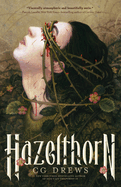
A teenager, joined by the irresistible boy who tried to kill him, unlocks the mysteries of his guardian's murder and a malevolent garden in Hazelthorn, CG Drews's searingly atmospheric queer YA horror tale.
Seventeen-year-old Evander does not remember the 10 years of his life before Laurie Lennox-Hall tried to bury him alive in the gardens. After the murder attempt, Evander's guardian and Laurie's grandfather, Byron Lennox-Hall, locked Evander in a room of the Hazelthorn Estate, where he has stayed for the past seven years. Now, Byron has died, and Evander suspects murder. Laurie may be a suspect, but so too are Byron's other kin. Evander, pale, weak, and prone to "episodes" during which he loses time, seeks investigative help from Laurie despite Byron having forbidden them to be alone together. Yet, perhaps due to "starvation" or "deprivation," Evander "craves" the "disreputable," cornflower-blue-eyed young man. As Evander seeks answers, he finds more questions--about himself and about the hungry garden that wants to draw him back beneath its dirt.
Drews (Don't Let the Forest In) ensnares readers with botanical body horror, monstrous people, and charged romance. Evander, who is neurodivergent, seeks "normality," a goal gorgeously juxtaposed by his fantastically bizarre surroundings, and by the story's "normal" people intently portrayed as the true monsters ("I'm only a monster because they made me monstrous"). Drews excels at portraying disturbing and eccentric imagery ("lies have been placed like delicacies on his tongue"), and the convincingly inexplicable yet undeniable pull between Laurie and Evander. This is devourable horror and romance set against a malicious, vine-choked tapestry. --Samantha Zaboski, freelance editor and reviewer

| Publisher: | Margaret K. McElderry Books | |
| Genre: | Dystopian, Espionage, Romance, Thrillers & Suspense, Young Adult Fiction, Science Fiction | |
| ISBN: | 9781665960137 | |
| Pub Date: | November 2025 | |
| Price: | $21.99 |
| Children's & Young Adult |
by Chloe Gong
Chloe Gong (Our Violent Ends) delivers a fractured not-too-distant future in her electric, visionary dystopian cyberpunk trilogy opener, Coldwire.
Catastrophic climate disasters and rapidly mutating pandemics have forced most of the world's population to live virtually in "upcountry"--a computer-generated reality run by the corporate juggernaut NileCorp--while the less privileged remain "downcountry" in the deteriorating real world. In addition, the two most powerful nations, Atahua and Medaluo, are locked in a cold war. Eirale, a corporate soldier for NileCorp and Medan by birth, is stationed in downcountry, where she is framed for a crime and forced to work with "Atahua's most wanted anarchist" to prove her innocence. Lia, a Medan adopted by an Atahuan family, is a graduate of Atahua's military academy and must prove her merit in her final assignment: tracking down an Atahuan traitor in upcountry. Eirale's and Lia's missions converge around an AI program that could upend the countries' power balance and challenge the boundary between what's real and what isn't.
Gong shares a glimpse into a possible stark future through Lia's and Eirale's alternating perspectives, spotlighting child exploitation and corporate influence on government while discussing the complexity of relationships with social media and AI. Gong's well-thought-out world is complex and layered, giving rise to nuanced conversations about identity and otherness, whether that's related to a Medan not being Atahuan enough or a cadet feeling disconnected from reality. She also deftly poses questions about users' right to privacy, survival under capitalism, and resource equity. This high-stakes dystopian thriller is a cinematic blend of cyberpunk, political intrigue, and sharp social commentary. --Lana Barnes, freelance reviewer and proofreader

| Publisher: | Holiday House | |
| Genre: | Fantasy, Romance, Time Travel, Young Adult Fiction, Historical, Science Fiction | |
| ISBN: | 9780823458295 | |
| Pub Date: | November 2025 | |
| Price: | $19.99 |
| Children's & Young Adult |
by Kendall Kulper
Genevieve Newhouse and Ash Hargreaves don't mean to blow up the world, but the teens' intentions go exponentially awry in Kendall Kulper's A Time-Traveler's History of Tomorrow, an energetic and satisfying stand-alone volume in Kulper's series of historical speculative novels that includes Murder for the Modern Girl and A Starlet's Secret to a Sensational Afterlife.
Science wiz Genevieve is set to unveil her cyclotron, a device capable of creating "the first entirely man-made element," at Chicago's 1934 World's Fair. When the organizers learn she's a woman, they insist someone else present her invention then ignore her notes and set the power current nearly 10 times too high.
Ash grew up in an isolated Pennsylvania community led by Father Daily, who has predicted that the world will end on June 15, 1934, at the World's Fair. Determined to prove him wrong, Ash goes to Chicago to ascertain whether any of the showcased innovations hold world-ending power.
Ash and Genevieve collide just as her cyclotron explodes. Ash uses his ability to rewind time to save them--but they travel to 1893, four decades before the apocalypse they're trying to prevent.
Kulper's "back to the future" plot moves at a breezy pace as Genevieve and Ash, narrating in alternating chapters, face obstacles and find allies, including each other. The science in Kulper's science fiction is more timey-wimey than textbook, but the history in her historical fiction is spot on as it captures how powerful white men excluded the achievements of women and people of color from venues like the World's Fairs. Kulper has perfected the formula for thoughtful, engaging, and imaginative storytelling. --Stephanie Appell, freelance reviewer
| Publisher: | Annick Press | |
| Genre: | Media Studies, Zoology, Science & Nature, Curiosities & Wonders, Juvenile Nonfiction | |
| ISBN: | 9781834020136 | |
| Pub Date: | October 2025 | |
| Price: | $24.99 |
| Children's & Young Adult |
by Kate Simpson, illust. by Leila Rudge
Author Kate Simpson (The Paper Museum) and illustrator Leila Rudge (Gary) separate animal fact from fiction in their nonfiction book Unreal, a quirky and handy resource for science-minded children and educators alike.
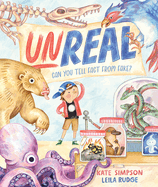
Oh no: some of the displays from the "Myths and Legends" exhibit were mistakenly brought to the "Natural History" wing inside a fictional museum! Unreal, which begins with a list of questions readers can ask when deciphering truth from lies, presents strange creatures alongside similar mythological counterparts and asks the reader to "sort what's real from what's not." Science, Simpson explains, "isn't about 'proof.' It's about evidence." While there may be no evidence of the roc, "a legendary bird of prey from Middle Eastern folklore," there is plenty of evidence for equally fascinating creatures, like the extinct moa or the burrowing turtle frog.
Simpson trusts child readers to handle nuance and addresses cryptids (Loch Ness monster) and popular hoaxes alongside their origin stories, explaining that sources traditionally considered reliable can fail and acknowledging that scientists have proposed theories later discovered to be incorrect. By the end of the book, all mythological creatures have been flagged as "unreal" and removed from the exhibit by the relieved werewolf caretaker. Rudge's use of colored pencils and watercolor paint creates a textured appearance that allows "nature journal" style double-page spreads to look scrapbooked and gives heft and density to creatures both real and mythical.
Unreal should be a wonderful addition to the shelves of readers who enjoy charmingly illustrated scientific graphic novels like I'm a Dumbo Octopus and deep dives into the niches of history like The Atlas Obscura Explorer's Guide to Inventing the World. --Nicole Brinkley, bookseller and writer