

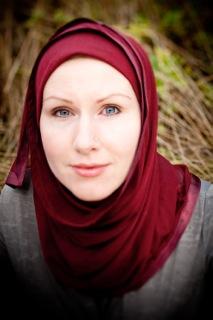
 G. Willow Wilson, Eisner Award nominee for her comic series Air and winner of the Seattle Times's 2010 Best Book of the Year award for her memoir, The Butterfly Mosque, divides her time between her native America and Egypt. She recently talked with us about her writing, the fantasy genre and her debut novel, Alif the Unseen.
How has your work on graphic novels influenced your novel?
Writing comics and graphic novels has had a profound influence on the way I write prose. The plotting of a graphic novel has to be lean and functional. There's no room for the extraneous bit of dialogue that goes nowhere, the subplot that never pays off. Cliffhangers have to correspond with page-turns, so that the reader doesn't immediately see the outcome on the facing page, thereby ruining the suspense. You're always working with a precise page limit. It's an incredibly rigorous art form. It gave me a deep appreciation for story structure, and I used that in my prose.
Threads of technology, religion, and magic intertwine seamlessly in Alif the Unseen. What gave you the idea to combine these elements?
There are so many fantastic conversations going on in the Middle East right now about the role of religion in the digital age, the changing face of politics, and the revival of myth. A lot of the dialogue in the book is culled from real discussions I've had with real people about these subjects. I spent a long time being frustrated that there wasn't much awareness or interest in Arab youth culture here in the U.S. People wanted to hear about fundamentalism and veiling and terrorism, but not about what the next generation was thinking or doing. The Arab Spring changed all that. Now people are taking the role of social media more seriously, and are looking ahead to the forces that will be at play in the new Middle East: a fairly progressive youth movement juxtaposed with various Islamist factions.
 How much of the djinn and their world is true to source material, and how much is your own imaginative spin?
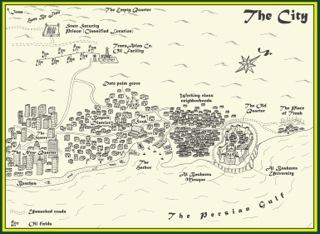
When I can, I always stay true to original mythology. All the tribes of djinn mentioned in the book--the marid, the effrit, the vetala and so on--come from ancient myths, though the vetala are actually culled from Indian folklore, not Arab. Since the Persian Gulf has a distinct cultural link to the Indian subcontinent through the millions of guest workers who live there, I thought it was appropriate. Effrit even appear in the Quran. I'm a big believer in the "you can't make this stuff up" school of making stuff up.
Could you tell us a bit about how you developed Alif's dynamic cast?
In this case, they practically developed themselves. Alif and Dina in particular seemed to evolve naturally on the page as I wrote. In general, I try to remember that each event in a story, including the most fantastic and surreal adventure, has a practical, emotional impact on the characters who experience it. Spending so much time between cultures, I've become somewhat oversensitive to the way people react to small slights, small changes, small disruptions. This makes it easier to visualize big ones. Several of the major characters in the book--Alif, Dina, the convert--have to deal with tensions surrounding class and ethnicity, and having lived my entire adult life shuttling between the U.S., where I grew up, and Egypt, where my husband grew up, those tensions are familiar to me.
 Most of the characters in Alif the Unseen are geeks, and small allusions to geek/nerd culture pop up frequently. Has geekery played a big part in your life?
I'm a veteran geek, albeit a semi-closeted one. I was into tabletop role-playing games in high school and I've been reading comics since I was a kid. I was a late but ardent convert to video gaming. The guy who got me into video games--or more precisely, into World of Warcraft--is a devout Muslim who looks like the kind of person who'd get three extra patdowns at the airport. Wooly beard, skull cap, the whole thing. Geekery is outsider culture and, in the Western world, Islam is also outsider culture, so there's a strangely natural affinity. When I go to ComicCon I'm usually just about the only woman in a headscarf, but it doesn't matter, because I'm standing next to a guy wearing hipster glasses and a Sailor Moon costume. We're all weird together. That crossover between outsider cultures is a big part of what drove me to write Alif the Unseen.
Why do you think the fantasy genre leans more toward Western mythology than Eastern, and do you see that status quo changing?
I think modern fantasy leans toward Western mythology because modern fantasy is primarily a Western genre. Tolkien explicitly set out to create a myth-cycle for the peoples of the British Isles whose cultures were lost after the Norman invasion. C.S. Lewis was reacting to the fallout of World Wars I and II on the British people, especially where faith was concerned, since he, like Tolkien and a lot of early modern fantasists, was a dedicated Christian. It was a culture-specific literary movement. What I've done in Alif is no different. As Lewis mined his politics and mythologies and beliefs, so I have mined mine. The fantasy genre is taking off in new cross-cultural directions--Saladin Ahmed, author of Throne of the Crescent Moon, is a good example of this emerging trend, as is Egyptian author Mansoura Ez-Eldin, author of Maryam's Maze. The Tolkienian tradition has gone global, and perhaps also digital. There are more stories to be told.
What are your plans for your next project?
I'm working on what I call my nautical novel. One of the characters from Alif appears in it. It's set in the midst of the Age of Exploration--over 500 years ago--so I'll let you guess which one. --Jaclyn Fulwood