

 |
|
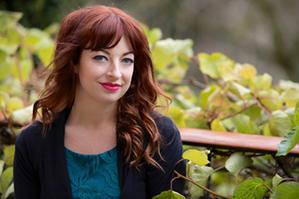
| Erin Grace Photography | |
Leslye Walton grew up in Tacoma, Wash., 45 minutes south of Seattle, where she now lives. Seattle is the setting for her debut novel, steeped in magical realism, The Strange and Beautiful Sorrows of Ava Lavender. "I wanted to ground my readers in the setting, so they could believe these bizarre characters existed," Walton said. Here she talks about many of the inspirations for her characters, and what the writers she admires have taught her.
What are the roots of The Strange and Beautiful Sorrows of Ava Lavender?
I was finishing up my student teaching and contemplating whether to go to grad school for writing or immerse myself in teaching. I was driving and listening to this song by Colin Haye, "I Just Don't Think I'll Ever Get Over You." He's having coffee, he's going out on dates--he's not wallowing, but he's never going to get over this woman. Suddenly I had this character Viviane Lavender, and she loves Jack Griffith for her entire life. I pulled over and wrote an outline. I got into grad school on that story. By the time I got out of grad school, all the other characters had shown up.
Tell us about how Ava came to you.
I have a younger sister. By 11, she was tall and gangly, all limbs. She wore old T-shirts of my Dad's, and she was always running. In this photo, this white shirt is billowing behind her. I wrote, "It looked as if she has wings." I thought, "No, this character has wings." Ava is a real girl, but this is a fantasy. Over the next few months, I was diving into magic realism--Gabriel García Márquez, Isabel Allende, Alice Hoffman....
Then, one morning Emelienne was there with her entire family. It took just 45 minutes to sit down and write that section of the book. Once I had Emelienne's family, I knew where to go.
Is that when it became an intergenerational story?
It grew from Viviane's story. It's Ava's story, but it's as much Viviane's [Ava's mother] and Emelienne's [Ava's grandmother]. It's about how our ancestors haunt our steps. There are remnants of all these stories, and they all collect underneath you like a foundation and help shape you. Life is more circular than we maybe want it to be. Ava discovers, "There was someone in my past who turned into a canary, and now I have wings." Even if you don't know the past, how much does it influence the present?
Gabe plays a key role in the novel, as the one in love with Viviane who looks out for her family. Is there a correlation with the Archangel Gabriel?
Yes. I think the Lavenders didn't need to be saved, but they needed someone that was going to quietly fight for them, particularly Viviane. I knew Gabe needed to be someone who came from no history, who could envelop himself in this very history-ridden family. As bizarre as the Lavenders are, they're very grounded. There's nothing grounding Gabe. I did name him after the angel Gabriel. I didn't want it to be controversial. Gabriel is the savior of the family. There will be the Jacks and the Nathaniels, but René [Emelienne's brother] is a good man. Rowe [Ava's best friend Cardigan's brother] is a good man.
Tell us about the origins of Wilhelmina Dovewolf.
I read a lot of Louise Erdrich in college. Between her and Alice Hoffman, that might have been in the back of my head when I sat down to write this. All the strange things that happen to the Lavenders wouldn't be strange to Wilhelmina. Nothing brings her down because of her past. I liked the idea of Emilienne having a partner who understood her.
My family will say, "Have you taken the dog to the vet? I have a feeling you should." Reading someone's aura is not bizarre to us. "Grandma was visited by Aunt Rhonda last night"--that's normal. When you come in contact with somebody else who's like that, you say, "I'm like that, too." Wilhelmina decides, this is where I'm going to stay; this is where I'll find my roots, with this woman who will understand me as much as I understand her.
Nathaniel Sorrows's extreme piety caused him to implode, didn't it?
I knew there was going to be something that was going to harm Ava's purity. I knew it would be someone misusing religion, hiding in religion. I wanted to make sure that it's not an anti-religious book. I hope I convey that in the scene when they bring Ava out, and all these people of different creeds pray not for an angel, but for a girl. While Nathaniel didn't have it right, other people do. We can mistake purity and piety--Nathaniel wanted so badly to be a pure person. He wanted to believe he was saintly.
Then there's Emilienne, who seems at times callous, yet turns out to be loving enough for the entire family.
Emilienne cares as much as she possibly can. The loves of her life were truly her siblings. I can't imagine losing them one after the other as horribly as she did. A woman who comes from no money, and deciding what were her options: to marry and get out of there. She'd have to have a child. Then she loses her husband. Then she has these annoying [apparitions of her] siblings who are trying to tell her something awful is coming, and she can't bear it. Finally, she has the strength to let everything in. We know at the end how much Emelienne loves them.
Do you do the plotting, or do your characters?
Both. My writing is very character-driven, so much so that when I'm really into something I have trouble existing in real life. Some of it was just them, and some of it was me forming that pathway. The three things that Henry [Ava's twin brother] says over and over, he came up with those. I didn't. The maps, that was a five-year-old child I worked with who was mute and autistic. He didn't ever make eye contact, and I'd had no idea if I was getting through. We were coloring, and he was making a map, down to the street signs. I thought, "I'm not giving you credit; you are paying such close attention."
Henry was going to have that ability to connect to both worlds, as Emelienne does. That would be his purpose, to try and warn. The one who could know would be the one who couldn't communicate. As much as Ava seems to be a magical creature, she's not. She has a physical manifestation; everyone else in her family has all the magical connections.
Are you working on another novel?
When I sat down and wrote Ava Lavender, I didn't know it was YA. My agent said, let me try to sell it as YA, and we sold it in four days. I feel like this is my place, where I need to be, who my audience is. My next book will be intentionally YA. It will be completely different. But it will have a lot of bizarre, memorable characters hopefully again. It's also magical realism. This is my genre. --Jennifer M. Brown