

The idea for a picture-book biography of the real Ivan, star of Katherine Applegate's Newbery-winning The One and Only Ivan, grew out of the author's visits to schools that had selected the novel for one-school/one-book reading experiences, during which "the principal, the lunch ladies, the crossing guards, everyone reads the book," according to Applegate. "Wouldn't it be great to include those kids not yet ready to read the novel?" suggested her editor Anne Hoppe. Hoppe then approached G. Brian Karas to do the illustrations; the result is Ivan: The Remarkable True Story of the Shopping Mall Gorilla.

|
|
| Katherine Applegate | |
Katherine, the first-person voice for your hero in The One and Only Ivan is so strong and so clearly captures Ivan's character. With this picture book you create a blend of both the factual and the poetic. Was it difficult to find the narrative voice for this one?
Katherine Applegate: It's definitely a different experience. All the raw materials were there. As anyone who's experimented with picture books knows, it's such a challenge. It's poetry. You have so little space to say so much. A lot of the story you have to cede to the illustrator. I went through many, many incarnations. I did know I wanted that beginning phrase and that ending phrase to come full circle--the way Ivan's life did.
Brian, most of your illustrations in picture books accompany a fictional story, which gives you full freedom to create your characters in whatever way you wish. But Ivan is a real gorilla. Did you feel at all inhibited by having to stick with the facts? Or did you find it liberating on some level?
G. Brian Karas: I'm used to working with fictional characters, so I had to really think of this book as a portrait of Ivan. What was so hard for me is that I had so little time to get to know not only gorillas but also Ivan. It was a daunting task for me at first. I started by reading The One and Only Ivan. That gave me great insight into him not only as the gorilla but also as a character, as a being.
I thought it would be helpful to watch live gorillas, to see how they move. They have such expressive faces. I really felt like I got to know Ivan; I watched a clip of Ivan being released into Zoo Atlanta onto the grassy area. There's a look on his face, so immediate and complex. In those few seconds, we see total confusion, not really understanding if that's meant for him. It was an emotional moment, for me, and I didn't know him.
Tell us about the cover.
|
|
|
G. Brian Karas |
|
GBK: The cover was a problematic part of the project. What you see is the result of many ideas that didn't work, and we finally settled on the image from that first spread. I ended up redoing that, in just a slightly different way. The mother's eyes aren't showing; Anne and I liked how it worked as a cover, but also how it began the steps that we see, with him going from being an infant to a slightly older gorilla.
How did you two work together?
KA: This was produced in fairly quick fashion. Kudos to Brian because he had to do the heavy lifting. We passed along some basic information and said "run with it." To me, I find the faces impassive, a little hard to penetrate--except for the eyes, which are incredibly human. What was amazing to me was the way Brian was able to convey these complex emotions, especially in the container with the two babies, and also with the gorilla families, where there's such joy.
GBK: I agree with the impassive expressions except for their eyes. Many people mention how humanlike they are. There's a funny thing about their mouths, too, depending on which angle you're looking at them from, they can seem to be frowning or looking proud. One of my favorite parts is in the beginning of The One and Only Ivan--about how he seemed angry all the time but he was really thinking about eating a ripe mango.
KA: The best spin you can put on it is they look mildly amused, but you're right. They mostly look grumpy. You don't want to get anthropomorphic, but you really connect with them in a profound way.
GBK: There was very little back-and-forth. The writing was so right, and so instructive to me in so few words. You talk about how it felt like writing poetry--I thought of the illustrations as writing poetry; in my mind they had to be just as spare. It's about what you take out as much as what you leave in. I don't know how much Anne [Hoppe] worked with you, but we worked together quite a bit, especially on the cover. I did a first round of sketches and there were very few changes in those, as far as structure and pagination.
KA: With Anne, there was plenty of back-and-forth. I think she's a poet herself. If a word doesn't work for her, it's "Katherine, try again." I get my best work out that way.
I think it helped a lot that the novel was there in the back of my head. I had done a lot of research on Ivan's life at the Tacoma Public Library and Zoo Atlanta. The pacing of his life as it unfolded was pretty clear, and we knew we wanted to have that initial idyllic stretch and compare that to how things went [in captivity]. There was some rejiggering to get it right.
Brian, tell us about the image of unloading the crate in Tacoma with the two baby gorillas inside. That's a key transition in the illustrations and in the story.
GBK: I was aware of showing the difference between the two worlds, and the palette was such a good way to do that. I showed the early days in the jungle as warm and sunny, using a cream stock. I used a gray stock for all the illustrations in the U.S. I wanted that spread to be kind of reminiscent of the landscape in the first scene in the jungle, and for readers to see parallels. Instead of swinging vines, we see power lines; instead of the waterfall, we see damp drizzle.
Let's talk about the spread that discusses Ivan's capture. That's essential to Ivan's story, and yet a tricky one to convey to picture-book readers.
KA: You have to think, who is my audience and how far can I go? And yet you never want to condescend, especially with nonfiction; you have to be accurate. To some extent, I knew Brian would do the heavy lifting on this, because it could be so visually frightening. My thought was "cruel hands" could be explained by a teacher, and of course Brian had to address that visually. There was something so startling and evocative to have Ivan looking up.
GBK: I wanted to be faithful to the story, but also not frighten readers. I was thinking of The One and Only Ivan. I thought of having dead gorillas in the background. I'm so glad Anne stepped in and said, "This is a bit too much, can we scale back on the horror of this scene and focus more on Ivan?" I think this is more powerful.
 |
|
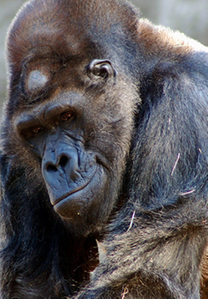
| Ivan | |
The contrast between the adult Ivan who "would have been ready to protect his family" and the human family peering in at Ivan through the window is so dramatic. Did you two work on that together? Even the green in his finger paintings on the wall suggest his longing.
KA: If you had to pick one picture that's emblematic of the story as a whole, and [Ivan's] yearning, it's perfect. Ivan was in that cage for 27 years, so you're glossing over decades trying to get across to children that a lot of time elapsed, and his needs changed. It's easier for a child to relate to the idea that you can't play anymore; you can't swing on vines. It's harder to convey that as you get older, you want to have children and protect them.
GBK: I do recall that I struggled a bit with that transition in the middle. Katherine tells the story of his lifetime in that very short span. As far as this particular spread, all I do is go back to the text and it tells me everything--what to show, what not to show. This idea that he had no family to protect was probably the saddest of his whole story to me. I wanted it to be an obvious image, where he's looking directly at something he's not. He may not understand, but we think he does.
Katherine, you build suspense in the scene where Ivan is being released into the acreage at Zoo Atlanta: "Finally, it was time./ Was Ivan ready?/ Cameras clicked. Reporters watched." And then we turn the page. In the next scene, we feel the emotion that the spectators feel as he ventures outside.
KA: It seems to me in an earlier incarnation, one of dozens, it was all statement. And then using the question--especially when you think of this being read aloud--seemed a natural way to introduce suspense.
GBK: I'd wanted to work with that image so much, when he first steps out onto the grass. I took some liberties with the text. We don't see the reporters and cameras and crowds until the next page. I think I wanted to keep that earlier image more mysterious. We intentionally don't see the end of that grass, it could be limitless. But we do step back on that next spread, we see, yes, we are in a zoo, it doesn't go off to eternity, which I suggest with that slope. In my mind, there was an end to this new world, it was enclosed. To him, it could be limitless. --Jennifer M. Brown