

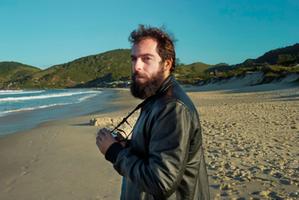
 Daniel Galera is a Brazilian writer and translator. He was born in São Paulo, and now lives in Porto Alegre, where he has spent most of his life. He has published four novels in Brazil to great acclaim, the latest of which, Barba Ensopada de Sangue (Blood-Drenched Beard), was awarded the 2013 São Paulo Literature Prize. In 2013 Granta named Galera one of the Best Young Brazilian Novelists. He has translated the work of Zadie Smith, John Cheever and David Mitchell into Portuguese.
What triggered your interest in writing?
What got me into writing was being a book lover since early childhood. I read tons of fiction. Actually, I experimented with other stuff first: drawing comics, playing guitar and writing songs, but nothing worked. I guess I was looking for a language to properly express myself, since I'm an introvert. Schoolteachers always told me I was a good writer, but I only took them seriously after I went to college to study media and advertising. There were creative writing courses in the program. I met other people interested in fiction and started to work hard on my first stories. The feedback I got there gave me more confidence, and soon I was joining writing workshops and publishing my stories on the Internet and in self-published books. Fiction was the place I could find and create meaning, where intriguing, disturbing and beautiful things were presented in a language I could fully participate in.
What or who influences you and your writing?
I could give so many incomplete answers to that. My nerve endings. Waves crashing. Wind farms. Philip Roth dialogues. The part of the iceberg that is below the waterline in Chekhov's stories. Post-rock and old blues singers. João Gilberto Noll's nameless characters. Mad Max movies. Personal anguish. Leonard Cohen songs. Some of Albert Camus's essays. Gothic landscape paintings. Free climbers. My Twitter timeline. There's no complete answer, though.
Your protagonist suffers from prosopagnosia, or face blindness. What made you decide to incorporate this into his character?
I read about it in Antonio Damasio's book The Feeling of What Happens: Body and Emotion in the Making of Consciousness. It's a fascinating condition, almost unbelievable. I thought: what a great idea, a character unable to remember faces, not even his own. When I started thinking about the protagonist in Blood-Drenched Beard, I realized this was the right story to explore that. I had a stranger from the city arriving in a small community, asking questions about an old crime involving his family, making friends and enemies, having love interests. Many interesting conflicts and tense narrative episodes could arise from his condition. In addition, I could work the face-blindness in the very language of the novel, since it's told from the protagonist's point of view.
What kind of research did you do into prosopagnosia in order to create it authentically in your character?
Besides Damasio's book, I read studies about it and did some Internet research. I found a few blogs and web forums where face-blind people discussed and shared their experiences. I learned how they suffer a lot because of it, how timid and socially awkward they tend to be, and also details such as the attention they pay to people's hands, since hands are the second most unique parts of our bodies, after the face. I imagined a lot of stuff, too. It can't be all research. After the novel was published in Brazil I met, by chance, a girl who was face-blind. She confirmed most things I knew or imagined about it.
Ironically, then, the protagonist--who cannot identify people by their faces--is the only character without a name.
I just like nameless characters. I've been trying to find a clever answer to that question since I published the novel, but I've quit. One thing I can say is that I wanted this character to be a sort of ghost the reader could inhabit, so I avoid describing him too much, and not mentioning his name helps, too. I'm sorry we now have to refer to him always as "the protagonist" or something, it's awful.
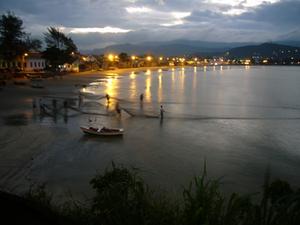 The seed for Blood-Drenched Beard came from a story your father told you about a murder in Garopaba. But you made sure not to ask anyone in the town about the murder. So did anything from that original story he told you seep into the plot, or was it all created in your imagination?
The story was just the tale about the murder of a man in Garopaba in the 1970s. It gave the contours to the murder of Gaudério in the novel. Gaudério himself, and all other characters, including the protagonist, are made up. There's no significant relation to my real family. But, yes, it all started with me wondering about that murder, and that's why I never asked about it in Garopaba, because I wanted to invent it and never breach the gate separating fact and fiction. The protagonist, his father, the investigation, the interplay between facts, myths and superstition--it all grew from that imprecise story that I had in my mind when I went to live in Garopaba.
What is your writing process like? How did the pieces and parts come together to create your story?
It began with the murder story, as I mentioned. I came up with Gaudério, his son and the grandson, who is the protagonist. I wanted the novel to be a lot of things: a chronicle of life in Garopaba, this small fishing village on the south coast of Brazil; an existential mystery novel, where a man finds himself while unsuccessfully trying to understand the death of his grandfather; an examination of themes such as determinism, the relation between historical facts, myths and superstition, the meaning of those things to life in a small community. It all came together during the 18 months I spent in Garopaba. I worked on my notes slowly, taking in my readings, ideas, experiences, stories I was told. I don't think one can fully plan a novel. To a great extent, a novel is a reaction to something that was already there, imprecise but urgent, something about the way you see things, and that you feel you need to transform into a story. You uncover a lot of it yourself by doing it.
How did the protagonist's relationship with Beta develop in the writing of the book?
Dogs have important roles in other works I have written. I wanted to avoid it in Blood-Drenched Beard, but somehow Beta, who was supposed to appear only in the opening chapter, became a protagonist in the novel, too. I decided the son would keep the dog, and then, of course, it becomes a symbol of his father, a living memory. I find man/dog relationships touching, but what interested me even more was making the reader feel that this man will do absolutely anything to keep the dog close and alive, no matter what. That leads to several critical events in the book.
You've said having distance from your subject matter is good for your writing. How so?
Too much knowledge about your subject can and will kill fiction. You have to know a lot about it, but the ideal "a lot" still leaves a lot in the dark, I believe. That's what you fill in with whatever is unique about your inner life, your style, your view of the world. Also, in my own personal experience, public discussion about a subject will interfere with my ability to create fiction that deals with my feelings about that subject. I don't expect everyone to agree with that.
Does your translation work affect your writing?
Translation does not affect my writing. Reading does. So it's great when I can translate a writer that inspires me, I can dig deep in his style, vocabulary, syntax. But influence and inspiration comes from reading.
You're very busy in the publishing industry, but when you aren't working, what do you enjoy?
I'm not that busy, really, now that I quit doing translations for a while. I write in the mornings after jogging and walking my dog. Here and there I write a review or essay, attend literary events. I try to read at least one or two hours every day. Like most people nowadays, I spend indecent amounts of time answering emails, net-surfing, checking my phone. I play video games. I swim and go to the gym when there's time. I feel I'm always busy, but thinking about it, it's seldom the case. I neither have kids nor work regular hours.
What's next?
I'm getting bald quickly trying to begin a new book. I have two ideas for novels that may or may not be connected, and for every minute I write, I spend half an hour thinking about what I'll eventually write. Part of the job. You just keep going until you have something. --Jen Forbus