

 |
|
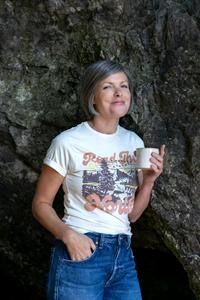
| Kelly Anderson (photo: Nicola Toon) |
|
Dr. Kelly Anderson is a family physician with fellowships in HIV and emergency medicine. She has worked in rural and remote emergency departments, spent 15 years at the Inner City Family Health Team at St. Michael's Hospital in Toronto, and built the clinical team at Felix Health. She completing the Bookends Novel Fellowship and the Gateless Writing Academy and is a certified Gateless writing teacher. Anderson spent much of her childhood in British Columbia, and now lives in Guelph, Ontario, with her family. Her first novel, The Wild Beneath (Park Row, August 4, 2026), is an astonishing story about beauty, magic, and loss on land and sea.
Where did this story begin, for you?
This story began in 2019 while I was quietly drowning inside my own life, working shift after shift in the emergency department. Somehow, even though I was highly functional and effective at my job, I felt disconnected and flat. I had forgotten what I wanted and needed. I never planned to write fiction. I was doing a three-point turn in my driveway on a winter morning; the sun was blindingly bright and I'd forgotten my sunglasses. It was Walker that found me first, and the idea that as people, we can turn into other things. Metamorphosis. I needed to find metamorphosis in my own life, and it started with writing the first lines of The Wild Beneath.
Those opening lines have a matching sense of huge change. Did that represent directly the need for change in your life?
I knew I wanted to feel more alive. But I had no idea how to do it, and it took me years to change the building blocks of my life. The closer I got to writing Annie's freedom, the more recognition I faced about my own unrelenting desire for it. Eventually, I left emergency medicine and academic medicine--two things I couldn't imagine doing before writing the book. I still practice medicine in ways that feel important and meaningful to me, but I had to change the containers I was in and build new ones.
You have been involved in two kinds of work that appear to be very different: medical practice and novel writing. How does one inform or inspire the other?
I think they're similar work, in that both writers and doctors care so deeply about understanding people. In medicine, we see the most unpolished, vulnerable versions of our patients. In writing, we're trying to understand human intimacies in order to make our characters feel real on the page--so we can benefit from their wisdom in our own lives. I love my work in medicine. It's a privilege, and it informs the way I write. It's an honour to be involved in healing, and at times, I watch modern medicine save lives. But writing is the thing that saves my own life--in small and big and repetitive and enlightening and surprising ways each day when I sit down at my desk.
Your characters and scenes are fully and physically tied to the natural world. Did that require research?
I wanted Hale's Landing to feel as real as possible, so readers could fall for the landscape in the same way I fall head-over-heels for the Pacific Northwest each time I'm there. British Columbia was my childhood home, so writing about it feels innate. But many experts shaped the details. I've read more whale articles than I can count! Understanding whale communication--the little we know about it--felt important to get right. I gathered everything possible about humpback songs; how they're shared and evolve over seasons and time. I am so grateful to all the wildlife, avian, tugboat, and forestry experts that were willing to spend hours on the phone with me (literally). Please check out the acknowledgements for a long list of these kind human beings.
Are writing and research separate processes?
Always back-and-forth. I write my scenes in uninterrupted 25-minute chunks. If I don't know something, I insert a placeholder and come back after I've researched.
More importantly, I watch for what surfaces in my own life as research. For example, while I was writing The Wild Beneath, friends would send me relevant documentaries or articles, and say, "I don’t know why, but I think you need to read-watch-see this." It would be an item about sperm whale clicks or tsunamis or women crossing the ocean in a sailboat or logging in Alaska. When things repeatedly surface in front of me, I take it as a sign it belongs in the book.
Where is the line between so-called hard science and magic?
Are science and magic separate, or actually the same thing at different points of human discovery? Is magic just science that we haven't discovered yet, or don't yet have the tools or language to measure? In medicine, I'm frequently reminded of how provisional our knowledge is--what we "know" about the body is often temporary and replaced by something else more "true." In the novel, the imaginative elements point toward what lies beyond our current knowledge of nature, but I wonder if parts of it could actually be true. What we call magic is the presence of mystery--the recognition that we can't fully explain life with our current models. I'm always on the lookout for magic. If everything were fully explained, there would be no awe, no reverence, no reason to keep listening.
Where do you find magic in medical work?
I think your question speaks to a more general human conundrum--where is the magic? Is there any left? When we aren't looking for magic, or believe there is none... we can't find it anywhere. We aren't sure it exists. But when we believe in something, the evidence for it grows because we're paying attention. To help me, I have a list in the back of my notebook called "proof that magic exists."
When I say magic, what I mean is: I believe that life is bigger than we can understand with the human mind, and that benevolent forces are all around us. I choose to believe this because I see it, and because it's a beautiful and supportive way to live. Because I'm looking for magic, I find proof of it in the smallest of places, including every day in medicine.
It feels like this story could have been set nowhere else than this stretch of Pacific Northwestern coast.
When I was little, I would wander the beaches of southern British Columbia and think to myself: everything is okay because the ocean is here. I believed it. I might still believe it. The trees and water in the Pacific Northwest feel primordial and wordless in a way that awes me. I have so much difficulty fully describing the awe that I had to write a whole book about it.
What are you working on next?
I'm in the middle of writing my second novel! It's a love story, with similar reverence for the natural world woven inside, and I'm excited to see how it unfolds. I also write a weekly Substack that explores writing, intuition and the mystery of being human. --Julia Kastner