

 |
|
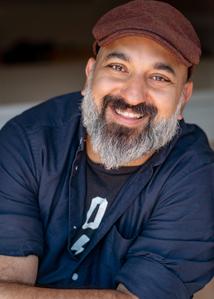
| Daniel Nayeri (credit: Reams Photography) |
|
Daniel Nayeri, born in Iran, was a refugee for many years before immigrating to the U.S. with his family at age seven. His books have won the National Book Award, the Michael L. Printz Award, the Newbery Honor, the Christopher Medal, and the Middle Eastern Book Award. Here, Nayeri, author of This Is a Door (Stonefruit Studio, October 27, 2026), talks about careening away from traditional formats, developing exuberant text, and believing that a person's ultimate purpose is to be useful for "the Good."
What was the inspiration for this project? Which came first, the story or the concept?
I was sitting around, as we all were, in March of 2020, doodling in my notebook and wondering where I might go in my imagination if I couldn't go anywhere in person. I found myself drawing a book jacket with the text "This Is a Door" over and over again. Eventually, I moved the "a" over a little to the right to look like a doorknob. And from there, I suppose I opened the door and stepped in. I knew I wanted to do something where the text was acting out the story, and for that reason I landed on a hero's journey. Something that hews as closely as possible to a basic plot (in terms of story structure) to careen as far as possible from the traditional format (in terms of type on the page).
When working with the interior designer, what was the process like? Did you work with physical or digital media? How did you convey your ideas?
First, I designed everything by hand in my notebook, and wrote all the text based on those designs. Then I arranged each spread in PowerPoint so that I could present the text in the form I intended it. After that, I worked with a freelance design firm. Lauren Vajda and I met decades ago as entry-level employees at a publishing company (I was in editorial; she was in design), and I have admired her work ever since. When I approached her about it, she immediately understood, and along with her team, took the designs into InDesign--along with many improvements!
The use of ellipsis as berries is so clever! What was your favorite visual to conceptualize, and what was your least favorite or most challenging?
There are so many little Easter eggs I love in this story. For instance, there is another moment when ellipses are used for an extended period of time, and the number of them is measured quite precisely. Without spoiling anything, my favorite parts are when the characters physically move around the page, whether by falling or by searching, or even by crossing over the "great divide" of the gutter in the middle.
The most challenging element is to present dialogue, along with the necessary dialogue tags, in such a way that feels elegant and flows naturally. After all, the traditional format of a novel is already a feat of design.
In some parts of the book, you use the double-page spread as if it were a single page, with some of the text starting on the right side of the page. Can you talk a little about how you made the design work without affecting comprehension?
Readability was a paramount concern for several reasons: first, I wanted the book to still work as a read-aloud or an audiobook because I love both of those experiences. I wanted to avoid puns or sight gags that needed puzzling out and would distract from the story. And I wanted the typographic aspect to feel playful, not esoteric, so that the most reluctant of readers would think of it as an attractive quality, as if the text was so exuberant in expressing itself that it was acting out the message.
As such, I avoided lots of designs that created what I called "multipath reading," which might arise in a crowd scene, for example, if I wanted to show everyone talking at once. We tried to observe the legibility rule of moving the eye from top left to bottom right, giving primacy to one, if not both, at all times. But, of course, these weren't hard and fast rules. The general idea was to prioritize design affordances that grab the reader's eye as quickly as possible after a page turn and take them on a journey across the pages.
There are a lot of emotional beats in the story. How did portray this with text?
In the most emotionally charged moments, I wanted the type to avoid distracting the reader. So, I often pulled back my initial designs in those sequences. There are times the design reinforces the idea that it portrays to amplify, and times when it subverts or counterpositions itself to create contrast (and one would hope, depth of meaning).
What are your favorite hero's journey stories? Which ones most inspired you when thinking about this story and why?
I suppose an adherent to the notion of a monomyth would say "they're all hero's journeys." And that was one of the intriguing aspects to me. I was effectively taking these elements that narratologists present archetypically to stand in for all manner of metaphors--the underworld can be the afterlife but also a desk job, a breakup, or a seedy saloon--and in a somewhat simple-minded approach, I was taking them literally and seeing if I could cobble a story out of them. Of the stories that look the most like a journey, J.R.R. Tolkien's The Hobbit will forever have my heart. Smith of Wootton Major (also by Tolkien) is another, along with King of the Wind by Marguerite Henry and Avi's The True Confessions of Charlotte Doyle.
Finding one's purpose is the main theme in this book. What is your advice for readers struggling to find their purpose?
The line that the main character holds on to is that his purpose is to be "the most useful to the Good God, and least useful to the bad ones." I like this construction because it implies that a purpose is an active calling, "to be useful," and from there guides the individual to ask themselves what their relationship might be with the Good, how can they serve its goals rather than their own. And in doing so, how can they make themselves useless to evil.
What do you most want readers to take away from this story and experience?
I think the best art begets more art. My hope would be that this story enchants and moves readers enough to inspire their own.
And lastly, what's next for you in terms of writing (or design!) projects?
I am still goofing around with hybrid formats. I would love to make a few more graphic novels. I am delighted by the idea of collaborating with designers and illustrators whose work I admire. Here's hoping. --Lana Barnes