

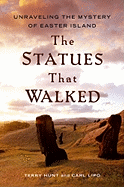
From the time the first Europeans arrived on Easter Island in the 18th century, Westerners have been fascinated by the island's monumental stone sculptures and baffled by how an impoverished prehistoric culture could have built them. The standard explanation was that the island had once been as fertile as other inhabited islands in the Pacific. Over time, its population committed ecological suicide, cutting down thousands of giant palm trees to support the statue cult.
When anthropologist Terry Hunt and archeologist Carl Lipo arrived on Easter Island in 2001, they expected simply to add a few details to the already well-developed account of its early history. In their fourth year of fieldwork, they found evidence of the giant palms that scholars believed covered the islands when Polynesian settlers first arrived. It was a major discovery. There was only one problem: the oldest layers were several hundred years later than the latest accepted date for colonization. If the island was deforested over decades instead of centuries, then everything archeologists thought they knew about the early culture of Easter Island was in question.
Hunt and Lipo reexamined, and rebuilt, archaeology's fundamental assumptions about Easter Island, using discoveries from other Pacific island cultures, local oral traditions, previously discounted field research, satellite images from Google Earth, studies by evolutionary biologists, accounts by early European observers, even game theory. They make a compelling case against the traditional version of Easter Island's prehistory. Instead of "ecocide," they describe a culture of careful environmental stewardship. And along the way, they prove how a small number of men can make a giant monolith "walk." --Pamela Toler, blogging at History in the Margins