

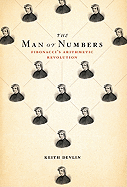
Blame our current obsession with numbers on 13th-century mathematician Leonardo Pisano, also known as Fibonacci. Leonardo authored the first general mathematics text, called Liber Abacci (The Book of Calculation), and introduced the European masses to a new way of doing math, using the universal 0 to 9 symbology developed by the Hindus and Arabs. It was a pivotal moment in history at a time when finger counting and Roman numerals were the norm, and accounting practices were more dubious than some of today's creative accounting.
Just as Leonardo brought modern arithmetic to Renaissance Italy, Stanford professor Keith Devlin brings the story of Leonardo back into sharp focus in this long-awaited tome. Devlin makes the genius (or foresight) of Leonardo easily understandable, as would behoove a fellow whose specializes in teaching and communicating mathematics in digestible chunks to general audiences. His 2007 Carl Sagan Prize for Science Popularization proves the point, as do his 28 books and role as the "Math Guy" on National Public Radio.
Leonardo's gift lay dormant for hundreds of years until Laurence Sigler translated Liber Abacci in 2002. Leonardo's place in history was now confirmed; his contributions extend beyond the mathematical sphere, forming the basis of modern banking and bookkeeping systems employed in business today.
For a brief instant Devlin lived and breathed Leonardo, a journey that still awes him. "Holding the manuscript in my hands was physical and visceral--knowledge through the body as opposed to knowledge of the mind," writes Devlin. "As I slowly turned the pages, Leonardo and his story suddenly became real." --Nancy Powell, freelance writer and technical consultant