

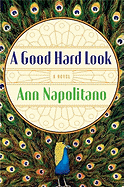
Flannery O'Connor is an endlessly interesting person whose life in Milledgeville, Ga., was circumscribed by chronic illness, yet was also one of keen observation and insight, informed by her strong Catholic faith.
Ann Napolitano (Within Arm's Reach) has created a series of characters with Flannery as their unwitting centerpiece. She writes, watches over her peacocks, ducks and other birds, spars with her mother and struggles with lupus. She has an abrasive personality, an acid tongue and no time for pretense. Because of these traits, lived out loud, some of her neighbors, nothing-but-polite-pretense Southerners, are forced to look at the progress of their own lives--and often find them wanting. They are also of two minds about her: proud of her accomplishments and dreading finding themselves on the page.
Prom queen Cookie Himmel returns to Milledgeville from two years in New York with a wealthy fiancé, Melvin Whiteson. She marries him, settles in to create the perfect home and has the perfect baby girl. Melvin, meanwhile, is drawn to Flannery, whom Cookie hates for reasons never really clear; in this regard, the author's cryptic style is annoying. Melvin gives her driving lessons and lies to his wife about it. He's fascinated by Flannery's peacocks, but what he enjoys most is being himself around her, when he feels that every other interaction is inauthentic. There is nothing improper about the friendship, except that he can't own up to it to his wife. When he critiques Flannery's stories by saying that she writes no happy endings, she replies: "I'm sure you didn't consider this... but it's possible that the characters are closer to grace at the end of the stories. Grace changes a person, you know. And change is painful." Much of the import of the novel is contained in that sentence.
Lona, a seamstress hired by Cookie, is married to a cop in an utterly soulless match. She falls in love with a young boy, and the change wrought in her brings several worlds crashing down. On the same afternoon, a tragic and hideous accident takes place at Flannery's that changes the lives of several people.
Flannery O'Connor was forced by illness to leave New York and return to Andalusia, the family farm, to live out her days. Dead at 39, she never realized the life she had anticipated. Instead of being bitter, she was occasionally saddened, but was buoyed by her faith and her writing. Her experience gave her an edge, an incisive quality that did not suffer fools gladly. There are plenty of fools to go around in Napolitano's book--but there is also realization, reconciliation and hope. --Valerie Ryan