

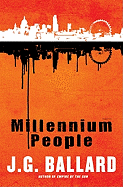
The psychopathology of late-20th-century everyday life was a recurring theme for J.G. Ballard, and Millennium People (first published in the U.K. in 2003) covers familiar territory for the late science fiction writer's fans. Psychologist David Markham is stunned to see his ex-wife in television footage of a bomb explosion at a Heathrow baggage claim. He doesn't want to know merely who set off the bomb, he wants to find out why they did it--so he begins attending protest rallies, looking for signs of violent extremism.
Markham falls in with film professor Kay Churchill, who has the right revolutionary mindset to have been involved in the Heathrow bombing, and she's tied to personalities like Richard Gould, a disgraced pediatrician who preaches a philosophy that casts the middle classes as "the new proletariat," oppressed not just by the capitalist economy but by its cultural conventions. Soon Markham is helping Kay torch the National Film Center, and getting pulled into even more insidious schemes.
Ballard presses his themes hard: there's a lot of talk about how "the middle classes are meant to be the great social anchor, all that duty and responsibility," and how cataclysmic it would be if they decided en masse to stop conforming to society's norms. Markham's journey into the terrorist subculture has strong echoes of Ballard's two immediately previous novels, Cocaine Nights and Super-Cannes, which also use the narrative structure of an outsider who discovers the sinister underbelly of a seemingly ideal, prosperous community. All of this is drawn out in Ballard's distinctively clinical tone, providing an aura of seriousness as Markham's world wavers between anarchy and nihilism, then finally comes to a seemingly safe--but subtly disturbed--resting position. --Ron Hogan, founder of Beatrice.com