

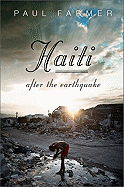
Anyone who has read Tracy Kidder's Mountains Beyond Mountains already knows that Paul Farmer is a rare individual who not only seems to have more than 24 hours in his day, but spends those hours focused on the betterment of others, especially the disenfranchised.
Haiti After the Earthquake is Farmer's comprehensive study of why the 2010 earthquake was largely an "unnatural" disaster that has been challenging to overcome. Farmer asserts that "rebuilding capacity--public or private--in Haiti requires sound analysis of what, exactly, has gone so wrong over the past four decades." Farmer's history of Haiti--the first successful slave revolt that lead to the first black republic--illustrates the tenacity and determination of its people. He then discusses why Haiti's "history of outsourcing almost every project to NGOs and contractors made trying to help the public sector like trying to transfuse whole blood through a small-gauge needle, or in popular parlance, to drink from a fire hose" and has made "building Haiti back better" difficult.
After describing the often disheartening attempts to rebuild Haiti, Farmer suggests the successful reconstruction of post-genocide Rwanda may serve as a model for Haiti, and then examines best- and worst-case scenarios for Haiti, circa 2015.
Haiti After the Earthquake provides a complex, wholly accessible study of the factors driving Haiti's future. -–Kristen Galles, blogger at Book Club Classics