

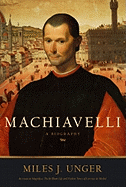
Niccolò Machiavelli (1469-1527) was labeled "the finger of Satan" by a prominent Cardinal in 1539, and his work was placed on the Papal Index of Prohibited Books in 1559. Miles Unger chronicles Machiavelli's rise to notoriety with the same flair that he brought to Magnifico: The Brilliant Life and Violent Times of Lorenzo de' Medici. From humble beginnings in Florence to his bureaucrat years and fame, on to his posthumous vilification by the Church, Machiavelli's life is observed with a Renaissance-like attention to detail.
As Florence's Second Chancellor, Machiavelli observed his city through multiple crises and believed that classical principles of statecraft lagged behind contemporary needs. He was candid to a fault when he wrote The Prince, sharing everything he had learned with the Medici who were coming in to govern Florence, but the powerful family dismissed him as a nuisance. As Unger remarks, The Prince has achieved fame as perhaps the most unsuccessful job application of all time.
"A lie, convincingly told, is among the most powerful weapon in the ruler's arsenal," Unger writes, explaining that Machiavelli did not follow his own tips for rulers. "Pointing out uncomfortable truths turned out to be an unpardonable crime, while countless acts of cruelty, treachery, and violence... were passed over with barely a yawn." Machiavelli should have known what would happen to him for speaking so plainly to the Medici, but could he have had imagined he'd be influential for centuries? Cynic that he was, he'd have laughed and asked how much his monetary award was.--John McFarland