

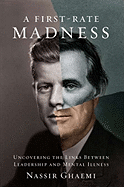
Consult any list of the traits that make a person fit for crisis-time leadership, and you're not likely to see "mentally ill" on it. In A First-Rate Madness, Nassir Ghaemi, a professor of psychiatry and director of the Mood Disorders Program at Tufts Medical Center, contends that perhaps that shouldn't be the case.
Applying principles of modern science and psychology to character studies of eight prominent historical leaders, Ghaemi argues that "in times of crisis, we are better off being led by mentally ill leaders than by mentally normal ones." Ghaemi identifies four elements of mental illness that promote crisis leadership--creativity, realism, empathy, resilience--and examines their manifestation in the lives of leaders who suffered from depression or bipolar disorder, leaders like Winston Churchill, Mahatma Gandhi, Abraham Lincoln and John F. Kennedy.
Ghaemi draws from public records and private documents to present data about each man's symptoms, family history, course of illness and treatment. He lays out his theory using language that is accessible, if not entirely jargon-free, and illustrates his case studies systematically and succinctly to establish a compelling argument for the link between certain types of mental illness and crisis-time leadership. The keyword here, though, is "link," and Ghaemi strays at times from the proviso that "correlation does not equal causation" to imply a more directional relationship than the evidence supports. Readers who bring both a passing familiarity with psychology and a healthy skepticism will find much food for thought in A First-Rate Madness. --Rebecca Joines Schinsky, blogger at The Book Lady's Blog