

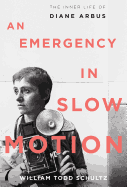
Forty years ago, Diane Arbus, the photographer best known for her shots of sideshow "freaks" and other denizens of the social underworld, swallowed two different barbiturates, climbed into her bathtub, slit her wrists and died. In his new study of Arbus, William Todd Schultz suggests that this overkill suicide (her first attempt) may have been just another strategy for this angry, tortured artist "to elicit support, to make people care and respond. What Arbus was after, most likely, was what she was always after--love."
Schultz, professor of psychology at Pacific University in Oregon, seems to be the go-to guy for the special genre of "psychobiography," having published articles about Sylvia Plath, Oscar Wilde, Jack Kerouac, James Agee and a book-length analysis of Truman Capote, Tiny Terror, just out this spring. He has made a career of sifting through artists' primary work, journals, conversations and anecdotes to uncover the often-scrambled brains behind their artistry.
Drawing on Patricia Bosworth's 1984 biography of Arbus, interviews with her octogenarian therapist, literary memoirs of her brother, the poet Howard Nemerov, and entries from her schoolgirl journals recently released by her estate, Schultz meticulously gathers the basic facts of her life and her public photographs into a portrait of a sensitive, concupiscent woman who "passed from the bright light, from a world of wealth in which she felt like a privileged exile, into darkness, the worlds of her subjects." Like her pictures, this dark inner life is not pretty... but it is discomfortingly enlightening. --Bruce Jacobs, founding partner, Watermark Books & Cafe, Wichita, Kan.