

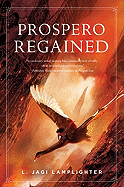
When Prospero Lost came out in 2009, L. Jagi Lamplighter's modern version of the characters from Shakespeare's The Tempest seemed to draw inspiration from Neil Gaiman, especially the Sandman comic book. It wasn't just that Prospero's daughter Miranda--now the head of a multinational corporation that keeps supernatural powers in check so they don't wreak havoc upon the earth--had a full contingent of equally immortal siblings, each with their own magical weapon. A more profound similarity lay in Lamplighter's efforts to create a totalizing worldview, one in which all mythologies and folklores are equally valid and capable of commingling.
Lamplighter built that premise up slowly in the first book and its sequel, Prospero in Hell, as Miranda struggled to reunite her estranged siblings after discovering that her father was being held captive by demons. Their rescue mission was disrupted on the very last pages of that second novel, and Prospero Regained picks up the story almost exactly where it left off, as the family slowly reassembles itself once more and then heads to the tower where their father is being held captive.
Prospero Regained also pushes the trilogy's theology in a new direction. From the beginning, Miranda has maintained that her devotion to the unicorn goddess Eurynome is not incompatible with her professed Protestant faith. During this final novel's long treks across Hell, there is much occasion for religious debate and Lamplighter eventually puts forward a scenario that strives to reconcile pagan pantheons with Christian views on salvation.
Unfortunately, this isn't a story you can jump into mid-stream, although Lamplighter recaps as much of the previous two novels as she can without dragging everything to a complete halt. To appreciate fully the magnitude of Miranda's dramatic transformation over the course of Prospero Regained, readers need the earlier books--but for contemporary fantasy fans who enjoy a healthy dose of the epic, that won't be much of a burden. --Ron Hogan