

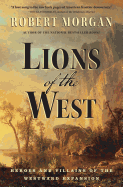
In Lions of the West, award-winning author Robert Morgan (Gap Creek; Boon) tells the story of the American march to the Pacific Ocean through the lives of nine men, including Thomas Jefferson and Johnny Appleseed.
Although Morgan devotes each chapter to a specific player, he emphasizes the connections between individuals and events, and ties it all together in an easy-to-read, attention-grabbing style.
Morgan succeeds in his goal "to create a living sense of the westward expansion" by keeping the focus of Lions of the West wide enough to discuss a variety of issues, such as Andrew Jackson's despicable treatment of the Creeks and Kit Carson's and John Frémont's odd codependency, as well as how David Crockett developed his marksmanship skills and why mules were the animals of choice for Indian scouts.
The best and the worst in American life can be seen in the winning of the West. The seemingly unclaimed lands promised opportunity, but the westward journey also created a sense of entitlement. As U.S. citizens moved onto the plains and beyond, they settled wherever there was good land or good game, without regard to national boundaries. Indeed, as Morgan notes, the federal government "only followed and made official what the vast movements of the rapidly growing population to the west had already made fact." Mexicans and Native Americans had decidedly different viewpoints.
It's fitting that Morgan closes with John Quincy Adams, one of the few people to have witnessed--firsthand or through his parents--the growth of the continental United States from the 13 colonies to the Mexican Cession. Just 14 months after Adams's death, gold was discovered at Sutter's Mill, leading to California statehood and rumblings of civil war. --Candace B. Levy, freelance editor blogging at Beth Fish Reads