

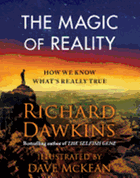
With The Magic of Reality, Oxford biologist Richard Dawkins (The God Delusion, The Selfish Gene) has written a popular science text that straddles young adult and adult readerships. This delightful work introduces readers to some basic scientific questions--"What is a rainbow?" or "Why do we have night and day, winter and summer?"--but also tackles the cosmological issues of when and how everything began, as well as addressing specifically humanist issues: "What is a miracle?" and "Why do bad things happen?" Most chapters begin with a survey of traditional myths that attempted to answer these questions; in the chapter on earthquakes, for example, Dawson retells the biblical account of Sodom and Gomorrah; the Japanese tale of the great catfish Namazu, who carries the land upon his back and rattles the earth when he flips his tail; and the West African myth that has humankind living in the hair of a giant who occasionally sneezes. His voice in these passages might remind the reader of the gently wry, self-deprecating explanations in Douglas Adams's The Hitchhiker's Guide to the Galaxy or perhaps the quintessentially British modesty of Stephen Fry.
This thoroughly enjoyable book is enhanced by the dazzling illustrations of Dave McKean, who has worked with such authors as Ray Bradbury, Stephen King and Neil Gaiman. As attractive and accessible as The Magic of Reality is, however, this work is not for every reader; those who disagree with humanist atheism are advised to stay away--for Dawkins, all religions with their deities are mere stories we tell ourselves. But for those who want a clear and enjoyable introduction to science, The Magic of Reality is a fine choice. --Judith Hawkins-Tillirson, proprietress, Wyrdhoard Books, and blogger at Still Working for Books