

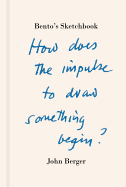
In a book that invokes the thought and spirit of the 17th-century Dutch philosopher Baruch Spinoza, artist, novelist, critic and activist John Berger (Ways of Seeing) offers an idiosyncratic glimpse at what inspires the human impulse to draw and uses that as a springboard to explore an array of artistic, cultural, political and personal subjects.
Sprinkled throughout the book's brief sketches are excerpts from Spinoza's writings, mostly his Ethics. Berger relates that the philosopher himself was known to carry a sketchbook that was never found when he died at age 44, and he tries to imagine what that book might have contained. To accompany his musings, Berger offers a generous selection of his own striking drawings.
But Berger presents more than abstract musings on art, philosophy or politics. There's a rollicking account of his encounter with a humorless security guard at London's National Gallery. He tells the moving story of a Cambodian refugee--an artist--he met while swimming laps at a pool in Paris and of the Japanese paintbrush he gave her that she used to render an elegant painting on rice paper of a bird perched on a bamboo stem. And he offers the poignant story of Luca, a French aircraft mechanic whose post-retirement dreams of taking his wife to all the destinations he visited during his career are shattered by her dementia.
Characteristically, Berger steers away from direct answers to the mystery of the artistic impulse or the many other questions he poses in this short book. "We who draw do so not only to make something visible to others," he writes, "but also to accompany something invisible to its incalculable destination." But the value of this impressionistic work lies less in those answers than it does in exposing us to new ways of encountering the world. --Harvey Freedenberg, attorney and freelance reviewer