

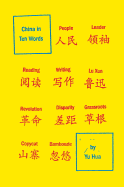
Words have the power to define life or death, freedom or tyranny, wealth or abject poverty. In Chinese history, "revolution" is the one word that has held sway over political ideology and cultural expression for the last half-century. But novelist Yu Hua (To Live; Brothers), also sees in the repressive tyranny of the Cultural Revolution a change in the subtle meanings of eight other words--and the reputation of the Chinese writer Lu Xun--all of which he explores in China in Ten Words.
Through the eyes of a youthful Yu Hua, we see how charismatic "leader" Mao Zedong spawned a revolution and united a "people" around the principle of wealth redistribution. But this "revolution" also changed how "reading" (through censorship) and "writing" (through simplified Chinese characters) were conducted, a consequence of a political philosophy centered on one figure. Decades later, violence, repression and economic "disparity" engendered a mentality focused on extreme capitalism, one where piracy and "copycats" emerged in a Darwinian quest for power and dominance by whatever means possible (hence, "bamboozle" becomes a term of endearment). Not even the standoff at Tiananmen Square could quash the seductive lure of the nouveau riche, leaving the question of morality and values open. "When society undergoes a drastic shift," Yu Hua writes, "an extremely repressed era soon becomes a very lax one."
Ten Words is a witty, wise and unflinching commentary on China's political past and crash course future. Its intimacy and immediacy should cement Yu Hua's legacy in Chinese literary circles as a master storyteller and documentarian. --Nancy Powell, freelance writer and technical consultant