

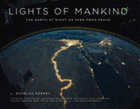
NASA has an archive of more than one million photographs that have been taken by its astronauts from outer space, but it wasn't until 2003 that someone designed a camera that could compensate for the 17,000-miles-per-hour speed of orbiting spacecraft and the Earth's rotation to deliver crisper, clearer images of the planet. This improvement revealed the spectacular glory of our nighttime world--thanks to lights, lots of lights, enough to consume 17.1 billion megawatt hours of electricity a year.
L. Douglas Keeney led a team that sifted through thousands of photos to compile this collection, one dramatic photo after another of the illuminated patterns that magically create Earth's own circulatory system. Here we see the Nile snaking its way north, here New York City awash in light. (And what's the single brightest "spot" on earth? Las Vegas.) Lights of Mankind is a spectacular picture book for parents to show children, for geographers and engineers or anyone who loves photos of Earth from space. --Thomas Lavoie, former publisher