

"I have no money, no resources, no hopes. I am the happiest man alive." For many, these early lines in Tropic of Cancer are akin to "Call me Ishmael." When Henry Miller went to Paris in 1930, he brought one book with him: Leaves of Grass by Walt Whitman (like Miller, a Brooklyn guy). Whitman was a singer, and Miller called Cancer "a song I am singing." Eighty years after its first publication, the book is ripe for reassessment and rediscovery.
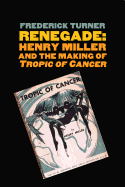
Frederick Turner (Culture of Hope) traces the story of Cancer, beginning by exploring the American culture of the period (perhaps in too much detail for some readers) to identify Miller's intellectual inspirations--as well as his unquenchable zest for adventure and improvisation, his often reckless exuberance and his outlaw personality. Miller was 38 and a failed writer when he arrived in Paris; he came under the influence of several artists and writers, especially Anais Nin, who, Turner shows, was even more influential in the writing of Cancer than Miller's wife, June. Nin also helped him get the book published at Jack Kahane's Obelisk Press in 1934 (including providing financial backing). That first edition's striking cover, done by Kahane's son, with a crab holding a woman's body in its claw, has become famous. Turner's claim that Tropic of Cancer was "more radically American" than anything published that year by Miller's contemporaries--even Faulker or Hemingway--and remained so for many years after, is debatable. But Renegade shows how, though the book's shock value has worn away, its literary significance, what Norman Mailer called its "revolution in consciousness," has endured. --Tom Lavoie, former publisher