

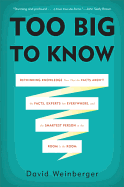
The growth of the Internet as both a means of transmitting information and a means of reconfiguring that information in new ways, at new speeds, has grown exponentially since the inception of the World Wide Web in 1990. Studies of the effects of this new medium on knowledge often, unsurprisingly, fall into "the Internet is good/neutral" or "the Internet is making us stupid" camps, depending on whether they're published on paper or online. Adding to this growing body of scholarship is David Weinberger's Too Big to Know--subtitled Rethinking Knowledge Now That the Facts Aren't the Facts, Experts Are Everywhere, and the Smartest Person in the Room Is the Room--focusing somewhat less on the effects of the Internet on the mind and culture than on the Ouroboros of information and the Web itself.
Weinberger, researcher at Harvard University’s Berkman Center for the Internet and Society, eschews the pedantic tone of similar books for a studied reflection on the Web, delivered with a wink. Building on Al Gore's stated belief that the Internet is the best hope for democracy, Weinberger notes that this is not a new idea: "The picture of reasonable people sitting together, talking over their differences in a respectful, honest way is the image on the Enlightenment's own Hallmark Card." His position is somewhat more pragmatic than Gore's, however, with considerable space given over to delineating how information management has transformed in recent years, shifting from a form where "facts" are published to a more fluid, dynamic networking of those facts. Weinberger's studies provide clearly lettered signposts in the directions future studies would do well to aim themselves. --Matthew Tiffany, counselor, writer for Condalmo