

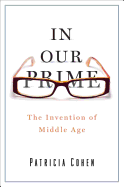
"What is the prime of life," Plato ruminated in The Republic: "twenty years in a woman, thirty in a man?" My, my, how times have changed. As Patricia Cohen observes, for the first time, "middle-age men and women are the largest, most influential, and the richest segment in the country. Floating between 40 and 64, they constitute one-third of the population."
In Our Prime is a fascinating biography of the "idea of middle age" in American society. Cohen's comprehensively researched account draws upon books, articles, newspapers and magazines to gauge shifting attitudes toward middle age from the late 19th century to the present day. She explains how scientific work from the 1890s to the 1920s convinced us that a series of distinct phases in life was biologically determined--it was "as natural as teething."
After World War I, the cult of youth and physical virility, as promoted by people like body builder Bernarr Macfadden, took over. It wasn't until the 1960s and '70s that sophisticated psychological studies and an increase in the value placed on physical well-being combined to make middle age the new "prime." From there, capitalism feasted on baby boomers like a ravenous hawk. Thanks to the influential work of social scientists like Erik Erikson and Bernice Neugarten on adult development, middle age became more "respected." Now, as Cohen points out, thanks to science and wiser doctors and patients, people between 55 and 75 constitute in many ways the new "middle age." It's a time of "extravagant possiblities." --Tom Lavoie, former publisher