

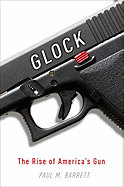
"Glock is the Google of modern civilian handguns; the pioneer brand that defines its product category," declares journalist Paul M. Barrett (American Islam). "Its boxy shape, black finish, and almost defiant lack of grace became the standard." His extensive, 15-year research into his subject has led to a riveting portrait of corporate intrigue and paranoia, political wrangling, Hollywood glam and deadly battle.
Once, Colt or Smith and Wesson revolvers, icons of the American West, were standard issue for law enforcement officers. But these heavy firearms had low load capacities and were difficult to shoot accurately in the best of circumstances. The 1980s cocaine gangs, armed with caches of semiautomatic and automatic weapons, began to "outgun" law enforcement, and a 1986 Miami shootout where armor-heavy men trained in militaristic combat killed two FBI agents and severely wounded two others was a turning point.
Brass fittings manufacturer Gaston Glock developed a large-capacity, molded plastic weapon to replace the Austrian Army's World War II-era Walther P-38. The weapon that made its debut in 1982 fit the army's criteria: large load capacity, maneuverability, durability and fast-shooting action. The Glock 17 initially spawned a maelstrom of negative publicity in the U.S., but its features and firepower earned the loyalty of police departments nationwide, replacing revolvers as the weapon of choice and becoming the symbol of American law and power.
In Glock, Barrett explores the life of the man, the machine he created, the empire it spawned and the inner circle responsible for its successes, scandals and politics. He makes a significant contribution to the ongoing discussion over gun ownership and gun control. --Nancy Powell, freelance writer