

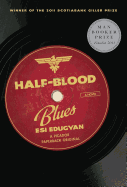
Sid Griffith, a light-skinned bass player from Baltimore, narrates as he and his childhood friend, dark-skinned drummer Chip Jones, leave the U.S. for the more racially and musically tolerant Europe to play the smoky clubs of Berlin. They are joined by four German musicians: an aristocrat on clarinet, a burly alto sax player, a blond-haired Jew on piano and Thomas Hieronymus ("the Kid") Falk, a rare German-born black man, on trumpet. Hitler's Germany soon becomes as intolerant of jazz as it is of blacks and Jews, however, and the Hot-Time Swingers flee to Paris in hope of a recording session with their hero, Louis Armstrong.
Edugyan's prose sparkles not only with the jive and banter of jazz musicians, but also with the metaphors of a music built on improvisation. None of the players has the gift of the Kid, who in "one pure, brilliant note" can create "the sound of something growing a crust, some watery thing finally gelling... the very sound of age, of growing older, of adolescent rage being tempered by a man's heart." In a moment of jealousy over the Kid's brilliance, however, Sid betrays him; the war catches up with the other German band members and the two Americans barely escape back to Baltimore.
Edugyan doesn't ignore the racism of the rural South, the inner cities, the clubs and restaurants, but she subtly uses the novel's setting to explore racism's even deeper horrors. Still, Half-Blood Blues suggests that perhaps the universal language of jazz can lead the way to a time beyond such prejudices. --Bruce Jacobs, founding partner, Watermark Books & Cafe, Wichita, Kan.