

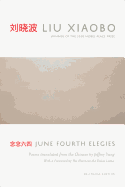
The highest calling of poetry might be in witness, the ability to depict important, history-altering events from the ground level with the highest level of wisdom and lucidity.
June Fourth Elegies is a stellar example of this, a work that is an unflinching catalogue of government-induced misery, a testament to the human spirit's capacity and a creative work of the highest order. The poems were inspired by the Tiananmen Square protests that the Chinese government ended forcefully, in blood, on June 4, 1989. Nobel Peace Prize recipient Liu Xiaobo took part in these events, and his poems are relentless and harrowing in the recounting of all that was lost on that day and in the years since. They are rage-filled, eloquent, devoid of easy comforts; they brim with survivor's guilt, explicit rage against the government and implicit rage against his fellow citizens who turned a blind eye to the shameful events.
As an important event in world literature, June Fourth Elegies speaks in brave, penetrating language of all that can be lost when totalitarian governments run rough-shod over their own people and of the compensatory balms of great poetry, even when it's an unadorned howl of rage. --Donald Powell, freelance writer