

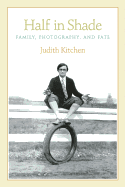
Poet and essayist Judith Kitchen opens a door into her past with short vignettes of family life in Half in Shade. A picture may be worth a thousand words, but when Kitchen delves into boxes of inherited family photographs and scrapbooks, she discovers that more words would have been useful in deciphering the who and the why behind each picture. Using her skills as an observant writer, she examines each black-and-white photograph from edge to edge, but can only partially decipher the context behind each image. She yearns for more information to understand the full significance of the time, the people and the places. For instance, in one snapshot of nine women hanging off the running boards, roof and rumble seat of an old car, Kitchen questions why the message written on the back says "note car," instead of a list of the women.
Kitchen opens windows of speculation with her minute inspection, especially with those photographs that could be of her mother. Was she really so full of spunk, with such a "sense of play?" Kitchen remembers her as "a chide. A disappointment. A silence at the core." When Kitchen is diagnosed with cancer, she questions her own existence and searches for deeper meanings in the photos and journal entries written by her teenage mother; anything to help link the past with her current condition. Kitchen's ruminations linger long after Half in Shade is finished, leaving readers to question how much we really know about the people who become our parents. --Lee E. Cart, freelance writer and book reviewer