

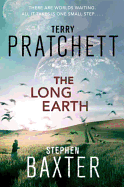
The device looks like a science fair project: a box filled with wires, a switch and a potato. Kids worldwide rush to assemble this curiosity... then start to disappear. So begins Step Day, the watershed moment in human history where our earth becomes many--and the premise underpinning The Long Earth, an expansive collaboration between speculative fiction stars Terry Pratchett and Stephen Baxter.
These boxes, called Steppers, allow people to "step" into the earth of a parallel dimension. Such alternate worlds extend in perpetuity, becoming more alien with every step away from the original earth. Joshua Valienté, the methodical orphan protagonist, is a stepping prodigy; he can step without a Stepper and is immune to the temporary nausea usually induced by trans-world travel. He is hired to survey the Long Earth via an airship controlled by Lobsang, a supercomputer (supposedly) containing the reincarnated soul of a Tibetan repairman. Lobsang behaves like the archetypal sentient supercomputer by continuously acquiring knowledge on the world(s) around him and mastering the subtleties of human social interaction. His relationship with Joshua evolves during their journey via power struggles, mentor-versus-protégé role reversals and humorous bickering.
Pratchett and Baxter explore the scientific possibilities behind interdimensional earths with enough detail to fascinate science fiction aficionados but won't alienate readers unversed in quantum physics. The book's fantastical subject matter is presented seriously, though Pratchett's absurd humor pokes through: a British World War I soldier mistakes hairy aliens for Russians and a nun rides a Harley-Davidson, among a sprinkling of other funny moments (most of which occur between Joshua and Lobsang). The Long Earth is the solid start of a series with infinite potential. --Tobias Mutter, freelance reviewer