

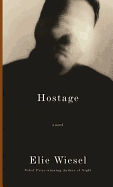
Set in mid-1970s New York, Elie Wiesel's Hostage recounts the nightmare experience of Shaltiel Feigenberg, who is seized by two terrorists--one Arab, the other Italian. The young writer's claim to celebrity is modest, and there's no obvious reason he's been singled out. But his ordeal becomes more compelling when we learn he survived the Holocaust as a child in Galicia, hidden by a German count while his father was deported to Auschwitz and his mother died from an untreated medical condition.
Over several days, Feigenberg is beaten and confronted repeatedly by his kidnappers. Ahmed is an abusive, fiery revolutionary, while Luigi, though equally fervent in his radical beliefs, prefers to engage in civilized conversation with his prisoner.
Unsurprisingly, Wiesel's novel overflows with stories, the chief vehicle Feigenberg relies upon to maintain his sanity. Whether it's the parables of some of the Hasidic masters whose work Wiesel has helped popularize or his protagonist's accounts of the chess matches he played against the German count as a terrified boy, these tales prove, as the mystic One-Eyed Paritus, a recurring character in Wiesel's novels, puts it, "God created man and gave the storytellers the task of saying why." Eventually, it becomes clear the writer is being used as a bargaining chip to secure the release of three Palestinian prisoners.
Hostage sums up many of the themes Wiesel has pondered in a long and distinguished literary career. "In the face of memory," Feigenberg observes, "joys and sorrows merge." That statement could serve as a fitting epigraph for this spare, provocative work. --Harvey Freedenberg, attorney and freelance reviewer