

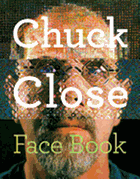
Chuck Close's honest, personal memoir about his life and work makes an ideal book for kids who find school challenging, who are creative or who see the world a bit differently from their peers. In other words, this one's for most everyone.
Close describes his road to becoming an artist as one of necessity. As a dyslexic student who also struggled with math and with memorizing names and dates, he found a way to master the material. For instance, he made a 10-foot-long illustrated map of Lewis and Clark's expedition for history class. "Art was what I did to convince others that I was interested in school," Close writes. "It was what I did to feel good about myself." His best-known paintings also resulted from Close's desire to surmount a challenge. He suffers from prosopagnosia, or face blindness: "But if I can flatten someone's face, I have a much better sense of what he or she looks like." He takes a photograph of his subject, and his portraits distill those photographs into grids comprised of tiny squares.
Step by step, Close describes his process of painting a face square by square. The question-and-answer format of the book also reflects Close's learning style. The book's brilliant centerpiece consists of a series of overlays: his self-portraits, divided into thirds, line up precisely, forehead to forehead, chin to chin. It illustrates the importance of those small squares, the difference between a horizontal/vertical grid versus a diagonal grid, the effect of watercolors or woodcuts on a mood. A winner. --Jennifer M. Brown, children's editor, Shelf Awareness