

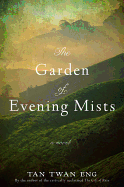
"History is filled with ironies," writes Tan Twan Eng in The Garden of Evening Mists, a novel that touches upon an often overlooked episode in the history of the World War II: the enslavement of, and cruelty visited upon, Chinese and European citizens during the Japanese occupation of Malaysia. What results is a quiet but forceful examination of the power of memory to sustain anger and to nurture forgiveness as it dissembles.
In 1951, Teoh Yun Ling, the sole survivor among her family of a brutal Japanese internment camp, arrives at the Malaysian home of Magnus Pretorious, a family friend and surrogate father, hoping to convince his neighbor, the exiled gardener Aritomo, to create a Japanese garden in her sister's memory. Instead, Aritomo apprentices Yun Ling so that she can learn and apply the principles of shakkei, "borrowed scenery," to construct her own garden. Yun Ling's imprisonment has driven her toward hatred and vengeance. Over time, however, she develops an intimacy with her teacher, as Malaysia disintegrates into political uncertainty.
Tan Twan Eng's second novel (after the Man Booker-longlisted The Gift of Rain) is lush with poetic resonance, an emotional but staid masterpiece of yearning for a stunted past and for connections that can never be. "A garden borrows from the earth, the sky, and everything around it, but you borrow from time," Tan writes. "Memories are a form of shakkei, too. You bring them in to make your life feel less empty." --Nancy Powell, freelance writer