

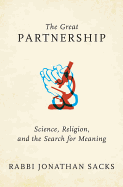
In The Great Partnership, Jonathan Sacks, chief rabbi of the U.K.'s main Orthodox movement, offers an examination of the most profound issues of faith and science that is both intellectually rigorous and generous in spirit.
With an impressive range of scholarship that extends far beyond the Jewish tradition, Sacks marshals an array of arguments for the proposition that "we need both religion and science." He strives to convince us religion doesn't require "the abdication of the intellect, a silencing of critical faculties."
Early in his argument, Sacks sets up a dichotomy between the analytical modes of science and religion, tracing the split to the clash between the left-brained world of the Greek philosophers and the right-brained world of the Hebrew Bible. "Science takes things apart to see how they work," he writes. "Religion puts things together to see what they mean."
In prose that's both stately and accessible, Sacks devotes extensive discussion to topics like evolution, the problem of evil and the excesses of religion. He explicitly refrains from offering elaborate philosophical proofs for the existence of God, calling such an effort "misconceived." It's less important for Sacks to prove that a divine being exists than to live as if one does; thus, he mostly avoids direct confrontations with the more polemical statements of Dawkins and company. He does, however, single out for criticism Sam Harris's denunciation of "religious moderates" and call for a hostile encounter between fundamentalists and atheists--the unappealing extremes between which Sacks steers with considerable dexterity. --Harvey Freedenberg