

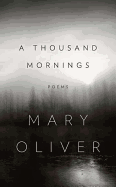
If you're one of the many, many fans of National Book Award- and Pulitzer-winning poet Mary Oliver, you'll very much welcome A Thousand Mornings.
One can't help but share in Oliver's love and enthusiam for life and the world around us, for "songs the shepherds sing, on the/ lonely mountains. while the sheep / are honoring the grass, by eating it." In one of the best poems in the book, "Tides," a single sentence running five stanzas explores what the "blue gray green lavender" low sea has left behind, from the "harbor's / dark-colored undercoat / slick and rutted and worm-riddled," to "barnacle-studded stones dragging / the shining sheets forward, deepening, / pushing, wreathing together / wave and seaweed, / their piled curvatures / spilling over themselves." When this description is complete, she adds:
"And here you may find me
on almost any morning
walking along the shore so
light-footed so casual."
So casual: Oliver's poetry seems that way on the surface, but look below and life rages, despite the hardness and disappointment the world can offer up. As she writes in "Lines Written in the Days of Growing Darkness":
"So let us go on, cheerfully enough,
this and every crisping day,
though the sun be swinging east,
and the ponds be cold and black,
and the sweets of the year be doomed."
A Thousand Mornings closes with a moving poem about Oliver's dog Percy that echoes Christopher Smart's famous poem to his cat Jeoffrey; dog lovers will shake their heads in a sad understanding and compassion: "For he was made small but brave of heart." --Tom Lavoie, former publisher