

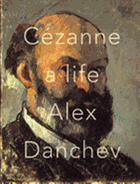
If the price of an artist's work measures his stature, the $250 million paid for Cézanne's The Card Players in 2011 suggests he was the greatest artist in history. As Alex Danchev's biography details, Cézanne certainly was prolific: "His lifetime production of paintings was 954," Danchev reports, but "to these should be added 645 watercolors and around 1,400 drawings." He was also repetitive--or, more charitably, drawn to the same subjects (such as bathers, his wife and his sleeping son) over and over again.
These and many other arcane specifics of the career that arguably ushered in the era of "modern art," are carefully noted throughout Cézanne: A Life. We learn the nuances of his paint mixing and knife work, his annual stipend from a disapproving wealthy father, the original prices of his work, even his daily log of meals (lots of "beef and kidneys"). More importantly, Danchev outlines the observations of his early close friend Zolá and later friend and mentor Pissarro (among many others) as he fills in a comprehensive portrait that includes the entire rich panoply of notable artists and writers in late 19th-century Paris. Forget the price of The Card Players; Cézanne's stature is perhaps better exemplified by Heidegger's words of admiration: "He said: 'Life is terrifying.' I have been saying just that for forty years." It takes some kind of genius to express that in a bowl of apples. --Bruce Jacobs