

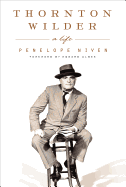
When people think of Thornton Wilder these days, it likely involves a vague memory of a high school performance of Our Town. Few know Wilder's other plays or bother to read his seven novels, like The Bridge of San Luis Rey. Thanks to Penelope Niven (Carl Sandburg: A Biography), this void in American literary biography has been exquisitely filled.
Thornton Wilder: A Life is biography as biography should be, and as the conservative classicist Wilder would no doubt have wanted. Niven quotes extensively from "ninety banker's boxes" of papers at Yale, the letters of Wilder's many friends, and conversations with his family and colleagues.
In straightforward, mostly chronological chapters, Niven taps Wilder's own words to tell much of his remarkable story and that of his equally literary family. They lived peripatetic childhoods in Wisconsin, California, Connecticut, China and Europe as his father struggled to raise them according to his strong convictions and earn enough to educate them, while serving his country as a diplomat. Wilder's was a writing family--letters, books and journals became the glue that held the scattered family together. From this background, the shy Thornton emerged to become a lifelong world traveler, reader, scholar, teacher, playwright, actor, novelist, soldier, financially successful family benefactor and friend to seemingly everyone he met from Ernest Hemingway and Gertrude Stein to boxer Gene Tunney, actress Ruth Gordon and (perhaps his closest friends) critic Alexander Woollcott and University of Chicago president Robert Hutchins.
Penelope Niven's biography doesn't embellish the facts but lets Wilder's words and accomplishments quietly speak for themselves, fascinating chapter by fascinating chapter. --Bruce Jacobs, founding partner, Watermark Books & Cafe, Wichita, Kan.