

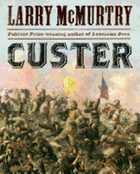
Larry McMurtry is best known for his fascinating stories of the American West. In Custer, he draws on an extensive personal collection of memorabilia and other references as he delves into the life of General George Armstrong Custer, and his famous last stand at the Battle of the Little Big Horn. Although he was reluctant at first to tackle yet another look at "Long Hair" (as the Cheyenne called Custer), given so many books on the subject already, McMurtry's expertise is evident in this short biography of the stubborn and complex man. From Custer's dismal record at West Point and his ambitious rise through the ranks during the Civil War to the final moments (or what is known of them) at the Little Big Horn, McMurtry offers readers a well-defined life study--richly illustrated with many paintings and newspaper clippings. Two hundred and sixty men died as a result of tactical mistakes brought on by Custer's ambition--yet he still became larger than life after his death, thanks in part to the rapid spread of the news via telegraph.
Little Big Horn was "really the beginning of the end for Native American culture, while at least allowing them [the Indians] one last surge of native pride," McMurty writes. "Long Hair casually underestimated them, and, by golly, they showed him." As McMurtry adeptly shows, Custer may have the last laugh, as his name is still recalled while those of the Cheyenne and Sioux at the battle have all but disappeared. --Lee E. Cart, freelance writer and book reviewer