

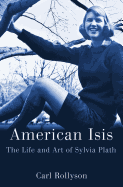
There have been other biographies of poet Sylvia Plath, who killed herself at the age of 30, but Carl Rollyson says those books focused too much on her psychological problems. By contrast, in American Isis, he compares Plath with the Egyptian goddess worshipped as the ideal mother or wife, calling her a "domestic goddess."
A precocious child, Plath was raised by her mother after her father's death and excelled at Smith College. One summer she interned at Mademoiselle in New York City; it inspired her novel, The Bell Jar. In 1953, she made her first suicide attempt. After graduation, she went to England on a scholarship, where she met and married the poet Ted Hughes, after knowing him for only a few months. Rollyson argues that Hughes never really understood Sylvia.
They moved to Boston, where she met the poet Anne Sexton. They would remain friends, helping each other out with their bouts of depression. The couple returned to England and she published her first collection, The Colossus, in 1961. A little over a year later, she learned of her husband's infidelity, moved out with the children, and a few months later put her head in an oven. Sexton callously called it a "good career move." Sadly, she may have been right--Plath's reputation has grown ever since.
Despite some lapses into purple prose and a predilection to compare Plath with Monroe (the subject of one of his previous biographies), Rollyson does a fine job of capturing the tortured life of this young, frustrated Isis who felt she could never do enough. --Tom Lavoie, former publisher