

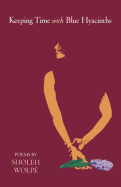
Iranian-American poet Sholeh Wolpe explores pain, personal and public, in her third collection, Keeping Time with Blue Hyacinths. The book is divided into four parts. The first uses an epigraph taken from Robert Frost: "The best way out is always through." Many of the poems in this section--"The Chill," "Matrimony," "Illusion," "Divorce"--are emotionally painful, as they speak about the breakdown of a marriage and love's leaving, filled with sadness and anger, loss and truth. "What's buried among their bed's decaying springs?" Wolpe asks in "Measure." "He says I love you, she says I love you/ to something she cannot see in the dark."
The second section uses an epigraph from Eliot's "The Rock" ("Where is the life we have lost in living?") to introduce poems about the past, Wolpe's schooling in England, her family and the Iranian home she can't go back to, as she tells us in the poignant "Sanctuary":
"Home is a missing tooth.
The tongue reaches
for hardness
but falls
into absence."
The poems in the third section are more political, like "I Am Neda." A young woman shot to death protesting Ahmadinejad's controversial election speaks: "Leave the Basiji bullet in my heart,/ fall to prayer in my blood." The final section talks about keeping time with spring's blue hyacinths, echoing Frost's simplicity:
"grace in movement, movement in grace,
like the lifting of a hand,
...the rotation of the heart."
--Tom Lavoie, former publisher