

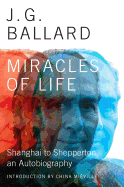
J.G. Ballard's haunting autobiographical novel Empire of the Sun chronicled his experiences as a young boy in Japanese-occupied Shanghai, where he was separated from his parents and put into a prison camp; his imagination helped him survive. Miracles of Life, Ballard's autobiography (and his last book before he died in 2009), returns to this formative period--and more.
In his introduction, China Miéville calls Ballard an "epochal writer" whose science fiction "sits like a single alien tooth in a human mouth." "Ballardian" has entered the 21st-century lexicon as a descriptor of the dystopian modern world and its effects on the human psyche: His novels portrayed a world filled with monstrosities of violence and urban debris intended to shock readers into emotions, reactions, especially repulsive ones. In 1970, when Nelson Doubleday actually looked at a collection of Ballard's stories he was publishing, The Atrocity Exhibition, he ordered all copies destroyed.
Ballard once arranged for an exhibit of crashed cars and hired a woman to walk around topless (she refused to go naked). Later, he wrote Crash--"my psychopathic hymn"--and gave the narrator his own name, "accepting all that this entailed." (Just as many know Empire of the Sun from Steven Spielberg's adaptation, you might also recognize Crash as a David Cronenberg film.) A quiet, loving family man, Ballard wrote haunting, even horrific books to show us what was happening all around us, over and over. He finally believed that it was no longer possible to "stir or outrage spectators by aesthetic means alone." --Tom Lavoie, former publisher