

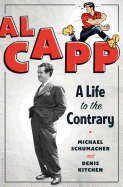
John Updike, a wannabe cartoonist, once described Al Capp's "Li'l Abner" as a "comic strip with fire in its belly and a brain in its head." Illustrator Frank Frazetta said Capp was "a brilliant guy--but a little screwed up." Indeed, Michael Schumacher and Denis Kitchen, two guys who know their comics, admit Capp was a "contrary individual" and their probing, critical Al Capp: A Life to the Contrary demonstrates why.
Capp (1909-1979) suffered a life-changing experience when he was nine years old and lost his leg to a trolley; he became a fairly cynical and sardonic person and it influenced his work. (A brief, autobiographical memoir was titled My Well-Balanced Life on a Wooden Leg.) He secured a job in 1933 working on the "Joe Palooka" strip, and in his spare time began his own strip about a handsome, stupid and likable guy who would become America's most famous hillbilly, Li'l Abner. Officially launched in 1934, the strip ran for 43 years on a regular basis. At its peak, one-half of all Americans couldn't get enough of Hogpatch, Daisy Mae, the Shmoos and the whole Yokum family; the strip's cultural impact includes the concept of Sadie Hawkins dances and slang like "hogwash" and "going bananas."
Capp became popular, rich and--in the 1960s--an insufferable, conservative bore. He used his strip to lash out at the counterculture and people like Joan Baez (caricatured as Joanie Phoanie) and Ted Kennedy (Senator O. Noble McGesture). A sex scandal finally destroyed a great career. --Tom Lavoie, former publisher