

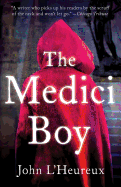
John L'Heureux did a considerable amount of research to re-create the world of 15th-century Florence in The Medici Boy, a story of love, art and murder. It's narrated by Luca Mattei, the son of a rich merchant and his Dalmatian slave girl, late in life. As a youth, Luca is sent to a monastery, where he is able to survive the Black Death, but sexual indiscretions force his departure.
Skilled at drawing, Luca apprentices to a painter in Florence, "that center of the arts, where painters and sculptors seemed to spring from the ground," and later with Ghiberti (whose bronze doors for the city's cathedral are famous to this day). He then has the good fortune to end up in the bottega (workshop) of Donatello, the "chief artisan of Florence," and this is when L'Heureux's story really begins.
Luca is thrilled and frightened watching Donatello sculpt in a trance-like state, his fingers almost floating as he works. L'Heureux beautifully captures the vibrant art world of 15th-century Florence and the personalities of the city's amazing artists, as well as Florentine power brokers like Cosimo de' Medici. We learn about the intricacies of sculptors' working methods in this era, as well as the hypocritical attitude toward sodomy (including the brutal methods for torturing and executing those convicted of it). L'Heureux's insightful portrayal of Donatello's creation of his majestic bronze David with Goliath's head--"the first naked sculpture in perhaps a thousand years"--is superlative. --Tom Lavoie, former publisher