

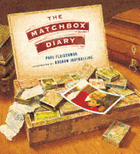
A man asks his great-granddaughter to pick an item from among his miscellany of antiques, books and knick-knacks, and he will tell her its story. It's an engaging way for them to get to know each other, and to draw in readers.
The child chooses the man's matchbox collection, from the days when matches were wooden and each box opened like a secret drawer. The matches are long gone, and in their place are everyday objects. The man tells his great-granddaughter the collection is his diary, "a way to remember what happens to you." At her age, he had a lot he wanted to remember, but he couldn't read or write. So these matchboxes served as a record of daily events. As a boy, the great-grandfather promised his own grandmother he'd never forget her or Italy and, as he waited for the steamship to take him across the Atlantic, he hit on the matchboxes a way to record his memories: his first soda (a bottle cap), the steamship (a hairpin from a wealthy passenger) and 19 sunflower shells, one for each day of the ship's journey.
Bagram Ibatoulline gets the vintage look of the matchboxes just right, while also planting both protagonists firmly in the present. Scenes of the man's impoverished childhood in Italy appear in sepia tones to distinguish his memories from the present-day exchange between the girl and her great-grandfather.
At the center of Fleischman's (Joyful Noise) story is a love of family and respect for education, which leads to the great-grandfather's vocation--and inspires an avocation for the young heroine. A heartwarming, universal immigrant story made poignant through specific details. --Jennifer M. Brown, children's editor, Shelf Awareness