

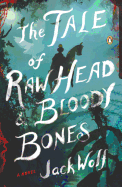
Jack Wolf's debut novel, The Tale of Raw Head and Bloody Bones, takes much of its inspiration from English fairy tales and folklore, and the language reflects its 18th-century setting. Tristan Hart, the narrator, is obviously brilliant and notably well-bred, but also clearly troubled. Prone to mental illness and psychosis, Tristan's recollections are inherently muddled and occasionally disturbing.
Tristan, despite his illness, leaves home to study medicine in London. While there, he realizes that he is irresistibly drawn to the practice of pain, whether preventing it medically or inflicting it personally. In attempting to understand this dichotomy, Tristan uses all of the knowledge and techniques available to him in this age of enlightenment. His research takes him beyond the laboratory to human experimentation, including sadistic practices that are ultimately carried out on his young wife. (She's a strange but suitable match for him, in that she is as willing to receive pain as he is to inflict it). Yet these efforts at self-understanding are confounded by Tristan's inability to distinguish reality from fantasy.
Some readers will find that the use of historically accurate English impedes their progress, while others may struggle with the scenes describing rudimentary surgery, human experimentation and sadism. Wolf maintains a fairly tight control over this ambitious and complicated novel, however, and readers who continue to the end will think about Tristan's story long after the final page. --Roni K. Devlin, owner, Literary Life Bookstore